Saint Cunera is a saint of the Catholic Church. Saint Cunera's feast day is celebrated on 12 June. Saint Cunera is the patron saint of Rhenen;cattle;cattle diseases;throat diseases.
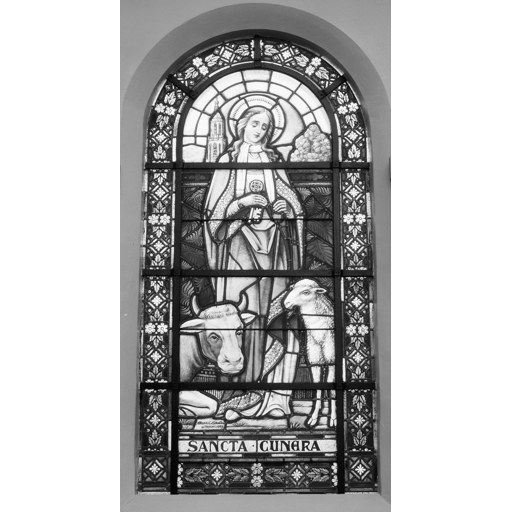
A. J. van der Wal
License: CC BY-SA 4.0
Saint Cunera
Saint- Feast Day
- 12 June
- Gender
- female
- Church
- Catholic
Places
Roles & Family
Patronage
Rhenen;cattle;cattle diseases;throat diseases
Biography
Saint Cunera, also called Kunera or Cunera of Rhenen, is a saint of the medieval Low Countries whose veneration is concentrated in the town of Rhenen, in the present-day Dutch province of Utrecht. Virtually all information about her life derives from later hagiography rather than from contemporary documents, and historians treat her as a legendary or at best historically unverifiable figure. The traditional account makes her one of the companions of Saint Ursula of Cologne, a British princess whose voyage with a great company of virgins and their subsequent martyrdom by the Huns became one of the most widely circulated legends of the Western Middle Ages. In that story Cunera was not killed at Cologne; a ruler associated with the Rhine took her into his household and brought her to Rhenen. No independent early source confirms her existence, her origin in Britain or the Orkney Islands (as some versions of the legend claim), or any date of birth. Assertions that she died in the fourth or fifth century simply follow conventional datings of the Ursula legend and have no documentary foundation.
According to the medieval vita, Cunera lived at the court in Rhenen as a devout Christian, distinguished by charity toward the poor and care for the sick. The ruler’s wife, jealous of Cunera’s reputation and of her husband’s regard for her, murdered the saint by strangling her with a scarf or veil and hid the body in a stable. The horses would not eat; the crime came to light; miracles were reported at the grave; and the murderess met a sudden, often supernaturally described, death. These episodes belong to a familiar repertoire of hagiographical motifs and should not be read as a recoverable historical sequence. A Latin life of Cunera was composed in the later Middle Ages, and Dutch versions helped spread the story in the northern Netherlands. In iconography she is commonly shown with the veil or scarf of her martyrdom, and sometimes with horses, recalling the discovery of her body.
Whatever the origins of the legend, a durable cult of Cunera took root at Rhenen. The parish church that came to be known as the Cunerakerk (Saint Cunera’s Church) housed relics attributed to her and became a pilgrimage site, especially in the later Middle Ages. The present Gothic church and its tall tower, the Cuneratoren, still dominate the town and preserve her name in the local landscape. Her feast day is 12 June. She is the patron saint of Rhenen and has traditionally been invoked for the protection of cattle and against throat diseases, patronages that reflect both the animal episode in her legend and the healing requests of pilgrims. The cult formed part of the religious life of the medieval diocese of Utrecht and of civic identity in Rhenen.
Critical scholarship does not attempt to reconstruct a factual biography. It is possible that an early grave or an older dedication at Rhenen attracted an Ursula-related legend and a name; it is equally possible that the entire figure is a medieval creation. What is historically secure is the existence of the cult, the church, the relics as objects of devotion, and the feast. Saint Cunera therefore stands as an example of a regional virgin-martyr whose story was grafted onto the Ursula cycle and whose memory was maintained by a specific Dutch town, rather than as a person whose birth, career, and death can be dated from reliable records.