Saint Cyril of Thessaloniki is a saint of the Eastern Orthodox Church (827 - 869). Saint Cyril of Thessaloniki's feast day is celebrated on 14 February; 11 May (with Methodius). Saint Cyril of Thessaloniki is the patron saint of Europe;Slavic peoples;Bulgaria;Czech Republic;Slovakia;Slovenia;Moravia;ecumenism;Christian unity between East and West.
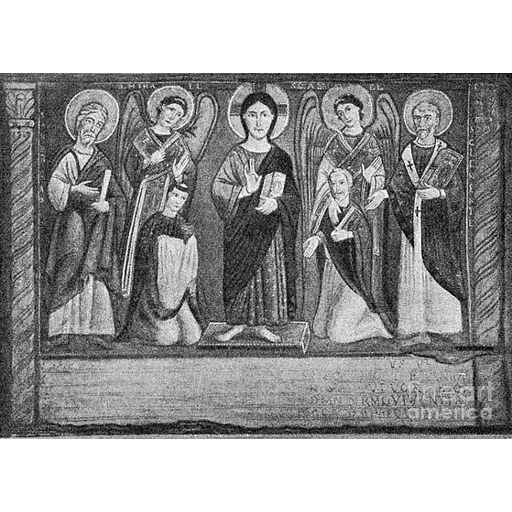
https://fineartamerica.com/art/paintings/greek+orthodox+saints
License: unknown
Saint Cyril of Thessaloniki
Saint- Life Span
- 827 - 869 (age 42)
- Feast Day
- 14 February; 11 May (with Methodius)
- Gender
- male
- Church
- Eastern Orthodox
Places
Roles & Family
Patronage
Europe;Slavic peoples;Bulgaria;Czech Republic;Slovakia;Slovenia;Moravia;ecumenism;Christian unity between East and West
Biography
Saint Cyril of Thessaloniki was born Constantine, the younger brother of Methodius, in Thessalonica (modern Thessaloniki) in the Byzantine Empire, conventionally dated to 827 on the basis of the near-contemporary Life of Constantine, which states that he was forty-two at his death in 869. His father Leo was a droungarios, a senior military administrator of the theme of Thessalonica; the family belonged to the city’s official class. Ninth-century Thessalonica was a major Aegean port whose hinterland included large Slavic-speaking populations, and later tradition reasonably credits Constantine with early familiarity with Slavic speech as well as Greek. He was sent to Constantinople for higher study, where he received the full trivium and quadrivium and philosophy, and was known thereafter as Constantine the Philosopher. He was ordained and served as chartophylax (librarian-archivist) of the Great Church of Hagia Sophia and as a teacher; he was associated with the circle of Patriarch Photius.
In the 850s and around 860 the imperial court used him on missions that mixed diplomacy with religious disputation. He took part in a debate at an Abbasid court on the Christian doctrine of God, and with Methodius he traveled to the Khazars, a mission during which the brothers are also reported to have recovered relics believed to be those of Pope Clement I in the Crimea and later brought them to Rome. These journeys established his reputation as a linguist and controversialist. When Rastislav of Great Moravia asked Emperor Michael III and Photius for teachers who could instruct his people in their own language, Constantine and Methodius were chosen. About 863 they entered Moravia with a new Slavic alphabet—the Glagolitic script, whose invention is attributed to Constantine—and with translations of the Gospel lectionary, Psalter, and core liturgical texts into the Slavic idiom that became Old Church Slavonic. Cyrillic writing, later named after him, was developed by disciples after his death, not by Cyril himself.
Frankish and Bavarian clergy in the region opposed the Slavic liturgy, arguing that only Hebrew, Greek, and Latin were legitimate sacred languages. After work in Moravia and a period in Pannonia under the Slavic prince Kocel, the brothers went to Rome to seek papal approval. Pope Hadrian II received them, approved the Slavic books, and had their disciples ordained. Constantine, already ill, received the monastic tonsure in Rome and the name Cyril. He died in Rome on 14 February 869 and was buried in the Basilica of San Clemente, where his tomb and relics have remained a place of veneration.
Cyril and Methodius were honored as saints in the East from the generation of their disciples and were later recognized throughout the Latin Church; their cult was extended to the universal Roman calendar in the nineteenth century, and they had no separate modern beatification or canonization process. Their translations and the scripts associated with them became the basis of Slavic Christian literacy and of the liturgical life of Orthodox Slavs and of some Eastern Catholic communities. In 1980 Pope John Paul II declared them, with Saint Benedict, co-patrons of Europe. They are commemorated on 14 February in the Roman calendar and on 11 May (24 May on the Julian calendar) in the Byzantine tradition, and they are invoked as patrons of Slavic nations and of reconciliation between Eastern and Western Christianity.