Saint Daniel is a saint of the Catholic Church.
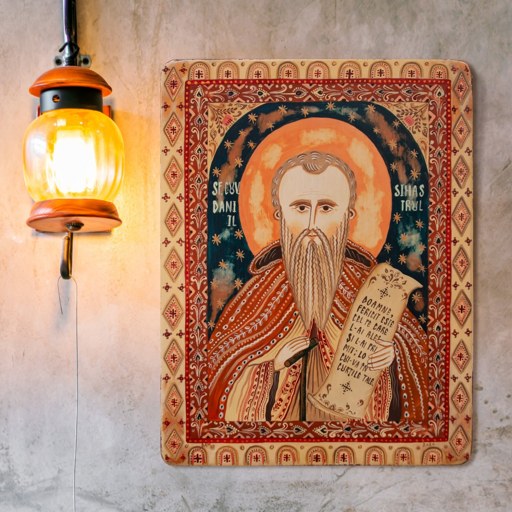
https://naivia.ro/en/wood-icons/177-wood-icon-saint-daniel-the-hesychast
License: unknown
Saint Daniel
Saint- Gender
- male
- Church
- Catholic
Roles & Family
Biography
The name Saint Daniel does not identify a single historical person. It is a homonym covering several distinct Christian saints, of whom the earliest and most widely known is the prophet Daniel of the Hebrew Bible and Christian Old Testament. According to the Book of Daniel he was a youth of Judean noble or royal stock deported to Babylon after the capture of Jerusalem in the early sixth century BC. In the courts of Nebuchadnezzar, Belshazzar, and the succeeding Median and Persian rulers he interpreted dreams, read the writing on the wall, and was delivered from a den of lions. Jewish and Christian tradition treats him as a model of fidelity in exile. The Roman Martyrology commemorates him on 21 July; Byzantine calendars keep 17 December. No extra-biblical source supplies a verifiable year of birth or death, and later claims that he was buried at Susa remain legendary rather than historically demonstrated.
A second major figure is Daniel the Stylite, an ascetic of the fifth-century eastern Mediterranean. Contemporary hagiography places his birth in a village near Samosata in Syria about the year 409. After a monastic formation and a visit to Symeon the Elder on his pillar, he established his own column at Anaplus on the Bosphorus, remaining there for more than three decades and advising emperors Leo I and Zeno as well as the patriarchs of Constantinople. He died in 493 and was buried at the foot of the pillar; a church was later built over the site. His vita is one of the better-documented stylite biographies of late antiquity.
In the Latin West, Daniel of Padua is venerated as a deacon and martyr. Medieval tradition, which cannot be confirmed by contemporary records, places his death in the second century and associates him with Prosdocimus, regarded as Padua’s first bishop. Relics attributed to him were reported discovered in 1075 beneath the church of Santa Sofia in Padua; he is commemorated on 3 January and regarded as a patron of that city. In Wales the sixth-century bishop Deiniol (Daniel) founded the monastery of Bangor Fawr in Gwynedd and is remembered as first bishop of Bangor, with a feast on 11 September. In Rus’, Prince Daniel Alexandrovich of Moscow, youngest son of Alexander Nevsky, lived in the later thirteenth century, founded the Danilov Monastery on the Moskva River, and is venerated as a holy prince in the Russian Orthodox Church.
A modern bearer of the name is Daniel Comboni, born in 1831 at Limone sul Garda. Ordained in 1854, he worked for the evangelization of Central Africa, founded the Comboni Missionaries and the Comboni Missionary Sisters, and served as Vicar Apostolic of Central Africa. He died at Khartoum in 1881, was beatified in 1996, and was canonized by Pope John Paul II in 2003. Other Daniels appear in martyrologies of Persia, Egypt, and the Celtic churches, usually with little more than a name, a feast day, and a brief legendary notice.
Because these persons lived in different centuries, regions, and churches, no unique year of birth, place of death, burial site, feast day, or patronage can be assigned to “Saint Daniel” as a single individual. Each biography must be reconstructed from the sources proper to its own era—biblical narrative, early Byzantine vitae, medieval Welsh and Italian traditions, Muscovite chronicles, or modern Vatican documentation—rather than treated as one composite life.