Saint David is a saint of the Catholic Church. Saint David's feast day is celebrated on 1 March. Saint David is the patron saint of Wales;Pembrokeshire;St Davids;vegetarians;poets.
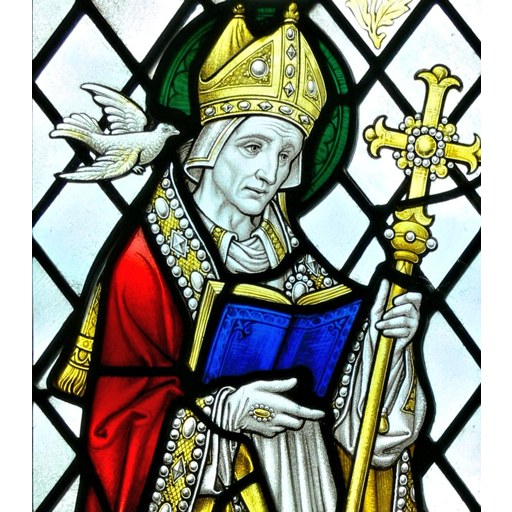
Wolfgang Sauber
License: CC BY-SA 3.0
Saint David
Saint- Feast Day
- 1 March
- Gender
- male
- Church
- Catholic
Places


Roles & Family
Patronage
Wales;Pembrokeshire;St Davids;vegetarians;poets
Canonization
Biography
Saint David (Dewi Sant in Welsh; Latin Davidus) was a sixth-century monk-bishop of the Brittonic church in western Wales and is venerated as the patron saint of Wales. No contemporary biography survives. The principal narrative of his life is the Latin Vita Sancti Davidis composed in the late eleventh century by Rhygyfarch (Ricemarchus), son of Bishop Sulien of Saint Davids, a text later reworked by Gerald of Wales (Giraldus Cambrensis) around 1200. These works were written to exalt the see of Menevia and cannot be treated as straightforward history. They place David's birth at Caerfai on the Pembrokeshire coast, the son of Sant, a ruler associated with Ceredigion, and Non, a woman later honoured as a saint; the ruined chapel of Saint Non near present-day Saint Davids marks the traditional spot. A violent storm and the miraculous spring that is said to have burst forth at his birth belong to the same legendary cycle. Irish and Welsh genealogies of a later date weave him into the network of saints of Britain, but the century of his activity—the so-called Age of Saints—is itself poorly documented.
David is presented as the founder and abbot-bishop of a monastery at Menevia (Welsh Mynyw), the site of the later cathedral city of Saint Davids, at the western extremity of the kingdom of Dyfed. Hagiography credits him with a severe monastic rule: the brethren refused to use animals for ploughing, drank only water, and lived on bread, herbs, and vegetables, whence his epithet Aquaticus or Dewi Ddyfrwr, David the Waterman. He is said to have been educated under Saint Paulinus at a monastic school often identified with Whitland (Henllwyn) in Carmarthenshire, and to have established or visited a string of churches and monasteries across south Wales and, in more ambitious later claims, in the west of England and in Brittany. Many of these dedications are better understood as evidence of the spread of his cult than as a reliable itinerary of the historical man. The community at Menevia became the mother house of a family of churches and the seat of a bishopric that, in the Norman period, asserted metropolitan rights over the other Welsh sees.
The most famous episode in the medieval Life is the Synod of Brefi, located at Llanddewi Brefi in Ceredigion. According to Rhygyfarch, David was summoned from Menevia to preach against Pelagian error; when the crowd could not hear him, the ground rose into a hill beneath his feet and a dove settled on his shoulder, after which he was acclaimed bishop or archbishop. A second synod, sometimes called the Synod of Victory, is said to have confirmed the same teaching. Whether these gatherings correspond to any real sixth-century council is unknown; Pelagianism as a live controversy in Wales at that date is itself debated. The story nonetheless became the charter myth of Saint Davids, justifying both David's personal authority and the later cathedral's claim to primacy. Other miracles—restoring a child's sight, providing water in drought, raising the dead—follow the conventional pattern of Celtic hagiography and cannot be verified.
Tradition holds that David died on the first of March at his own monastery. Medieval chronicles disagree on the year: the tenth-century Annales Cambriae enter the death of David, bishop of Menevia, under a date corresponding to 601, while the chronology popularized by Rhygyfarch points to 589. He was buried at Menevia; a shrine in the later cathedral of Saint Davids became a major pilgrimage destination. In the early twelfth century Bishop Bernard of Saint Davids obtained from Pope Callixtus II recognition of David's sanctity, an act conventionally dated about 1120 and accompanied by the claim that two pilgrimages to Saint Davids equalled one to Rome. The shrine was despoiled at the Reformation. David's feast on 1 March was observed in Wales throughout the Middle Ages and, from the eighteenth and nineteenth centuries, was increasingly celebrated as a national day, marked by the wearing of the leek or the daffodil. He is invoked as patron of Wales and of Pembrokeshire, and, because of the diet ascribed to his monks, is sometimes named patron of vegetarians; later devotion has also associated him with poets.
The historical David remains elusive. He belongs to the generation of western British monastic founders whose names survived in dedications, genealogies, and liturgical calendars while almost every biographical particular was supplied by much later writers. What can be said with caution is that a holy man named Dewi was commemorated at Menevia, that his cult was already important when Rhygyfarch wrote, and that by the high Middle Ages he had become the principal saint of the Welsh. Rhygyfarch attributes to him a farewell charge to his community to do the little things they had seen him do—Gwnewch y pethau bychain—words that have entered Welsh cultural memory even though their sixth-century authenticity cannot be demonstrated. His emblem is a dove; he is often depicted standing on a hill with a dove on his shoulder, in allusion to the Synod of Brefi.