Saint Dimitri of Basarabov is a venerable of the Catholic Church. Saint Dimitri of Basarabov's feast day is celebrated on 27 October. Saint Dimitri of Basarabov is the patron saint of Bucharest.
AnonymousUnknown author
License: Public domain
Saint Dimitri of Basarabov
Venerable- Feast Day
- 27 October
- Gender
- male
- Church
- Catholic
Places
Roles & Family
Patronage
Bucharest
Biography
Saint Dimitri of Basarabov, known in Romanian as Sfântul Dimitrie cel Nou (Saint Demetrius the New) and in Bulgarian as Dimitar Basarbovski, is an Eastern Orthodox saint whose cult is especially strong in Romania, where he is the patron of Bucharest, and in Bulgaria, where a rock monastery near the Danube commemorates him. Hagiographical tradition identifies his birthplace as the village of Basarabov (today Basarabovo, in the region of Ruse) in northern Bulgaria, on or near the river Lom. Romanian church tradition generally places his life in the thirteenth century; some later Bulgarian notices have instead associated him with the seventeenth century. No contemporary chronicle or inscription supplies a verified year of birth or of death, and modern historians treat the chronology as uncertain.
The traditional Life describes him as the son of a modest peasant family who worked as a shepherd in his youth. Drawn to asceticism, he later embraced monasticism and then withdrew to a cave in the limestone cliffs above the Lom, living as a hermit in fasting, prayer, and solitude. That eremitical pattern is typical of medieval Balkan monasticism and does not correspond to a named Western religious order. The present Basarbovo Monastery, a rock-hewn house of monks, occupies the site associated with that hermitage and remains a place of pilgrimage in Bulgaria.
According to the same tradition he died in his cave and his body was found incorrupt. At some later time a flood of the Lom is said to have displaced the relics, which were recovered and kept in the locality. In 1774, in the closing phase of the Russo-Turkish War of 1768–1774, the relics were removed from the Basarabov area by Russian troops. At the petition of the clergy and people of Wallachia they were not taken farther north but were brought to Bucharest and placed in the metropolitan cathedral, today the Patriarchal Cathedral of Saints Constantine and Helena. From that translation dates his prominence as heavenly protector of the city.
He is commemorated on 27 October in the Orthodox calendar. The sources present him as a celibate monk and hermit; there is no record of a spouse or of children, and he never held the office of bishop, patriarch, or pope. Orthodox recognition of his sanctity followed the pattern of local veneration and synodal acceptance rather than a Latin process of beatification and papal canonization. Devotion to him in Bucharest, especially at his feast, has continued from the late eighteenth century to the present.
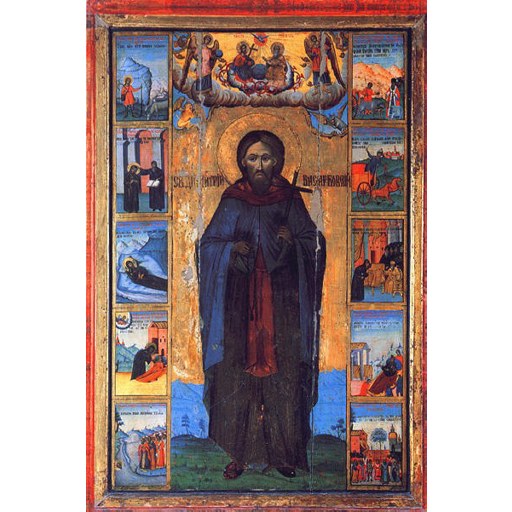
His iconography typically shows him as an elderly monk or hermit, sometimes with the cave or the river in the background. Scholarly literature on the saint remains limited: reconstruction of his earthly life depends almost entirely on liturgical synaxaria, local legend, and the well-documented eighteenth-century translation of the relics, rather than on medieval archival records. The Bulgarian monastery at Basarabovo preserves the memory of his original hermitage, while the relics in Bucharest remain the principal focus of his cult.