Saint Drogo is a saint of the Catholic Church (d. 1186). Saint Drogo's feast day is celebrated on 16 April. Saint Drogo is the patron saint of shepherds;sheep;cattle;coffee-house keepers;unattractive people;deaf people;mute people;orphans;hernias;ruptures;gallstones;broken bones;insanity;midwives;the sick;bodily ills;Sebourg.
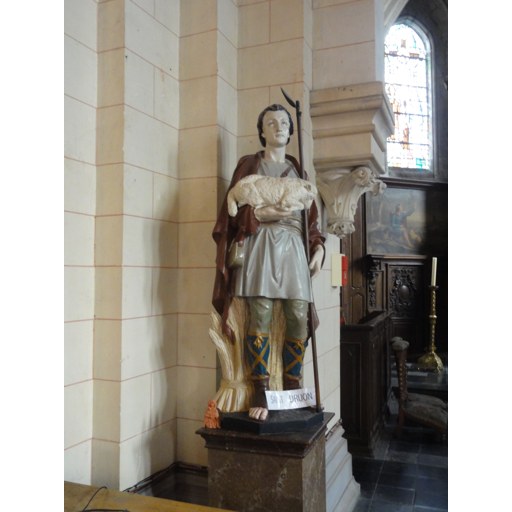
Chatsam
License: CC BY-SA 3.0
Saint Drogo
Saint- Life Span
- d. 1186
- Feast Day
- 16 April
- Gender
- male
- Church
- Catholic
Places
Roles & Family
Patronage
shepherds;sheep;cattle;coffee-house keepers;unattractive people;deaf people;mute people;orphans;hernias;ruptures;gallstones;broken bones;insanity;midwives;the sick;bodily ills;Sebourg
Biography
Saint Drogo, also known as Drogo of Sebourg, Druon, Dreux, or Drugo, was a twelfth-century hermit whose cult developed in the border country of Flanders, Artois, and Hainaut. Tradition places his birth at Épinoy, in what is now the Pas-de-Calais department of France; later writers give the year variously as 1105 or 1118, and no contemporary birth record survives. He is described as belonging to a family of local nobility. Hagiographical accounts state that his mother died in childbirth, a loss that later legend said filled him with lasting guilt and helped turn him toward penance. His father also died while Drogo was still young, leaving him an orphan with an inheritance. Around the age of eighteen, according to the same tradition, he distributed his property to the poor and left home to live as a pilgrim and a laborer rather than as a landed gentleman.
After abandoning his estate, Drogo spent years combining pilgrimage with humble work. He is reported to have traveled to Rome on several occasions; later legend often numbers these journeys at nine. Between pilgrimages he served as a shepherd at Sebourg, a village near Valenciennes in Hainaut, tending the flocks of a local household while practicing fasting and other austerities. The combination of hard physical labor and severe self-denial is the setting in which the sources place the onset of a serious bodily affliction, commonly described as a hernia or rupture, and in some versions as a disfigurement so marked that people found his appearance frightening or repulsive. These details belong to the legendary portrait of the saint as one who shared the lot of the sick and of those excluded from ordinary society.
In time Drogo withdrew from village life and had a cell built against the wall of the parish church at Sebourg. A window in the cell opened toward the altar, so that he could hear Mass and receive the sacraments without leaving his enclosure. He is said to have remained a recluse there for about forty years, living on alms and continuing a regime of prayer and mortification. Despite his seclusion, his reputation for holiness spread through the surrounding countryside, and he was credited with miracles of healing and of unusual knowledge. Pilgrims began to visit Sebourg already in his lifetime. He died on 16 April 1186 and was buried in the church beside which he had lived. He had never married and had no children; from young adulthood his life is presented as that of a celibate pilgrim, shepherd, and hermit, not as a member of any formal religious order.
Drogo was never the object of a formal papal canonization of the kind later regulated by the Holy See. His sainthood rests on local cult and long-standing popular veneration of the type often called pre-congregation. His feast is kept on 16 April. In later devotion he became a patron of shepherds and of livestock, of people suffering from hernias, ruptures, gallstones, broken bones, and other bodily ills, of the deaf and the mute, of orphans, of midwives, of those regarded as unattractive, and, in a more recent layer of folklore, of coffee-house keepers. The church of Saint-Martin at Sebourg, in what is now the Nord department of France, has remained the center of his cult and the place associated with his relics. Historical evidence for his life is limited to this regional hagiographical tradition. The outline of orphan, pilgrim, shepherd, and recluse is consistent across the sources, while a precise year of birth cannot be independently confirmed from contemporary documents.