Saint Emeric of Hungary is a saint of the Catholic Church (d. 1031). Saint Emeric of Hungary's feast day is celebrated on 4 November. Saint Emeric of Hungary is the patron saint of Hungarian youth;students.
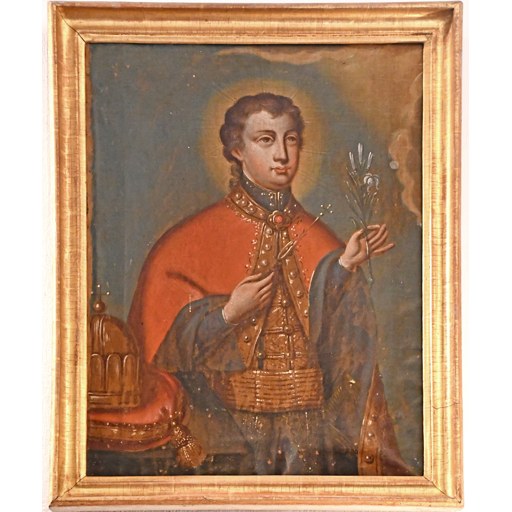
Pasztilla aka Attila Terbócs
License: CC BY-SA 4.0
Saint Emeric of Hungary
Saint- Life Span
- d. 1031
- Feast Day
- 4 November
- Gender
- male
- Church
- Catholic
Places
Relics & Where to Venerate
Location unknown
The bodily remains of Saint Emeric of Hungary are a first-class relic. Venerated at Székesfehérvár Basilica.
Roles & Family
Patronage
Hungarian youth;students
Canonization
Biography
Saint Emeric of Hungary, known in Hungarian as Szent Imre, was a royal prince of the Árpád dynasty and the son of King Stephen I of Hungary and Queen Gisela of Bavaria, a sister of the Holy Roman Emperor Henry II. Contemporary records do not preserve his exact year or place of birth; later tradition situates his birth in the first decade of the eleventh century in the Kingdom of Hungary. As the intended heir to a recently Christianized realm, he was educated at court for kingship. One of his instructors was the Venetian Benedictine Gerard, later bishop of Csanád. King Stephen addressed to his son a treatise of moral and political counsel, known as the Admonitions, which outlined the duties of a Christian monarch toward the Church, the great men of the realm, guests, and the poor.
Medieval hagiography, above all the early twelfth-century Legend of Saint Emeric, portrays the prince as an exemplar of chastity and devotion. That legend states that he married—often identified in later retellings as a Byzantine princess—yet lived with his wife in continence. Independent eleventh-century evidence for the marriage and for the bride’s identity is lacking, and historians generally treat the virgin-prince theme as a hagiographical ideal. It is historically certain that Emeric was designated to succeed his father and that he participated in the public life of the kingdom as a young man.
Emeric died on 2 September 1031 after being fatally wounded by a wild boar while hunting. Later Hungarian chronicles associate the accident with a forest in the region of Bihar. He left no children. The sudden loss of the heir produced a succession crisis in the last years of Stephen’s reign, including the blinding of the king’s cousin Vazul, and after Stephen’s death in 1038 the crown passed to Peter Orseolo amid civil conflict. Emeric was buried in the royal basilica at Székesfehérvár, the customary coronation and burial church of the Hungarian kings.
In 1083, during the reign of King Ladislaus I and with the approval of Pope Gregory VII, Emeric was canonized together with his father Stephen and Bishop Gerard. The translation of his relics established his cult among the principal native saints of the Hungarian Church. His feast is observed on 4 November. In subsequent centuries he was venerated especially as a patron of Hungarian youth and of students, and artists commonly depicted him as a young prince holding a lily as a sign of purity. His historical significance lies both in the political consequences of his early death for the early Árpád monarchy and in the use of his sanctity to reinforce the Christian identity of the kingdom founded by his father.