Saint Homobonus is a saint of the Catholic Church (d. 1197). Saint Homobonus's feast day is celebrated on November 13. Saint Homobonus is the patron saint of Cremona;tailors;cloth merchants;clothworkers;merchants;businesspeople;garment workers.
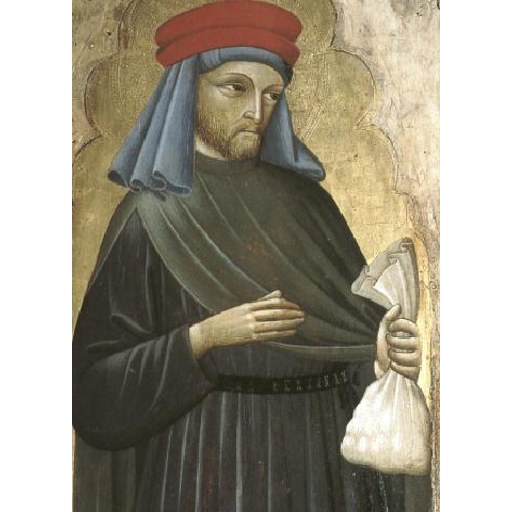
License: Public domain
Saint Homobonus
Saint- Life Span
- d. 1197
- Feast Day
- November 13
- Gender
- male
- Church
- Catholic
Places
Relics & Where to Venerate
Housed at Cremona Cathedral · Italy
His body is preserved in a crypt of the cathedral of Cremona
Roles & Family
Patronage
Cremona;tailors;cloth merchants;clothworkers;merchants;businesspeople;garment workers
Canonization
Biography
Saint Homobonus (Italian: Omobono, often given the family name Tucenghi) was a twelfth-century lay merchant of Cremona in Lombardy. His Latin name, Homobonus, meaning “good man,” is the form under which he entered the calendars of the Western Church. He was born in Cremona in the first half of the twelfth century into a family engaged in the cloth trade; no reliable contemporary source records an exact year of birth. He inherited and continued the family business as a cloth merchant and tailor, working within the commercial life of a prosperous Lombard commune. Medieval and later hagiographical accounts consistently present him as a man who practiced his trade with unusual honesty, refusing deceit in weights, measures, and contracts at a time when such integrity was held up as exceptional.
Homobonus lived as a married layman rather than as a cleric or professed religious. Tradition, already current by the time of his canonization, holds that he had a wife who did not always share his zeal for almsgiving and who at times reproached him for the scale of his charity. No securely attested name for his spouse survives in the principal historical notices, and the sources do not establish whether the couple had children. What is repeatedly affirmed is his daily round of work, prayer, and relief of the poor. He is said to have attended Mass every day, to have been devoted to the Eucharist, and to have given food, clothing, and money to the needy of Cremona, sometimes stripping himself of garments to clothe others. His habitual church was that of Saint Giles (Sant’Egidio) in Cremona.
He died in that same church on 13 November 1197, collapsing during Mass—later retellings often place the moment at the Gloria. He was buried at Saint Giles. Reports of miracles at the tomb, together with the advocacy of the people of Cremona and of Bishop Sicard of Cremona, led to a rapid papal inquiry. On 12 January 1199 Pope Innocent III canonized him, issuing the bull Quia pietas. The interval of little more than a year between death and canonization is among the shortest in medieval papal practice. Innocent III’s act is historically notable because it presented a married layman, sanctified in ordinary commercial and domestic life rather than in the cloister or the episcopate, as a model of Christian holiness; the pope stressed works of mercy and integrity in secular occupation.
Homobonus was not a member of a religious order, nor did he hold ecclesiastical office. His cult remained especially strong in Cremona, where his relics and memory were associated first with Saint Giles and later with the cathedral, and it spread more widely through the later Middle Ages. He is commemorated on 13 November. Because of his trade and his reputation for just dealing, he became the patron of Cremona and of tailors, cloth merchants, clothworkers, garment workers, merchants, and businesspeople. A church dedicated to him, Sant’Omobono, stands in Rome near the Capitoline, and his name continued to be invoked as an example of lay sanctity in the marketplace.