Saint Jaoua is a saint of the Catholic Church. Saint Jaoua's feast day is celebrated on 2 March. Saint Jaoua is the patron saint of Plouvien.
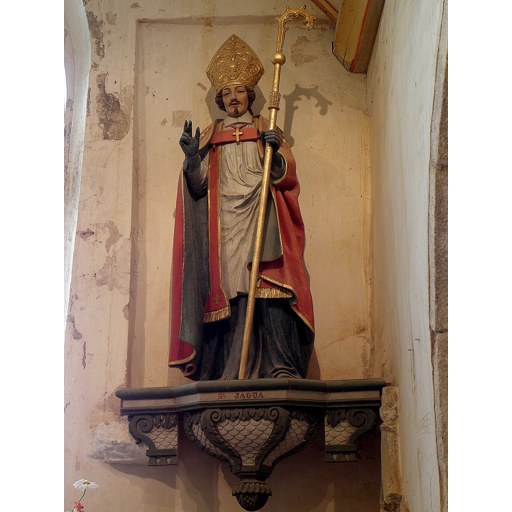
GO69
License: CC BY-SA 3.0
Saint Jaoua
Saint- Feast Day
- 2 March
- Gender
- male
- Church
- Catholic
Places
Roles & Family
Patronage
Plouvien
Biography
Saint Jaoua, known in Latin and English sources as Joavan and in Breton and French as Jaoua, Joévin, or Jaouen, was a sixth-century saint of the Léon country in northwestern Brittany. Almost nothing about him can be established from contemporary documents. The principal early narrative is the Life of Saint Paul Aurelian written in 884 by Wrmonoc, a monk of Landévennec, which presents Jaoua as the son of a sister of Paul Aurelian and therefore as that saint's nephew. Paul himself is described as a Briton from Wales who crossed to Armorica; Jaoua is accordingly remembered as a figure of the same Insular monastic migration. Later medieval and early modern hagiographers repeated and embroidered this kinship, but they added no independently datable facts. His year of birth is unknown, and even the generation to which he belonged is inferred only from the traditional chronology of Paul Aurelian.
According to this tradition Jaoua was educated in Britain in the clerical and monastic culture of the British Church and afterwards passed to Armorica, where he attached himself to his uncle's work in the pagus of Léon. He is described as a monk and, in some local memories, as a hermit. A strong Léon tradition makes him the founder or first abbot of a monastery at Daoulas, on the confluence of streams south of the Élorn; the later medieval abbey of Daoulas, refounded in the twelfth century for Augustinian canons, looked back to this legendary origin. Other accounts keep him in the immediate circle of Paul Aurelian at Ocismor, the later Saint-Pol-de-Léon. Distinguishing history from cult legend is not possible: no charter, inscription, or seventh-century text names him.
A further layer of legend holds that Paul Aurelian, wishing to lay down the episcopal charge of Léon, designated Jaoua as his successor, and that Jaoua, though unwilling, was consecrated bishop. The early episcopal list of Léon is too fragmentary and too late to confirm or refute the story, and modern historians generally treat Jaoua's episcopate as unproven. Stories of his reluctance, of miraculous signs attending his election, and of pastoral labours in the countryside belong to the common stock of Breton saint's lives rather than to recoverable biography. What can be said with more confidence is that by the later Middle Ages a distinct cult of Jaoua existed in the rural parish that became Plouvien, a few kilometres from the road between Landerneau and the coast of Léon, and that this cult identified him as a holy bishop and monk of the first Christian generations in the region.
Tradition places his death in the sixth century at or near Plouvien. A well-known local legend tells that neighbouring communities disputed possession of his body; the coffin was set on a cart drawn by oxen, which stopped of their own accord at Plouvien, taken as a sign of the saint's will. The church of Saint-Jaoua in Plouvien, a building of medieval fabric later altered, houses a fifteenth-century recumbent effigy of the saint over the tomb that has long been shown as his. Jaoua is the patron of Plouvien; his feast is observed on 2 March. He was never canonized by a formal papal process; his sanctity rests on ancient local veneration of the kind later classed as equivalent to pre-congregation canonization. For the historian he remains an obscure Insular-Breton monk of the sixth-century migration, whose name, kinship with Paul Aurelian, and burial at Plouvien are the most stable elements in a largely legendary dossier.