Saint Kilian is a saint of the Catholic Church (d. 689). Saint Kilian's feast day is celebrated on 8 July. Saint Kilian is the patron saint of Würzburg;Diocese of Würzburg;Franconia.
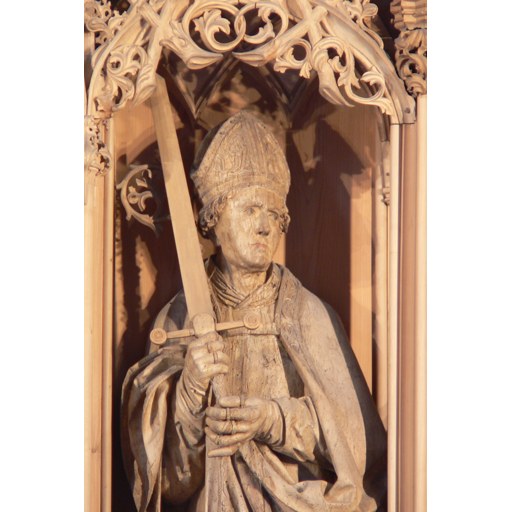
Joachim Köhler
License: CC BY-SA 3.0
Saint Kilian
Saint- Life Span
- d. 689
- Feast Day
- 8 July
- Gender
- male
- Church
- Catholic
Places
Roles & Family
Patronage
Würzburg;Diocese of Würzburg;Franconia
Biography
Saint Kilian, also known as Cillian or Killian (Latin: Kilianus), was an Irish missionary bishop of the seventh century who became known as the Apostle of Franconia. Contemporary documentary evidence for his life is lacking; the principal narrative source is the Latin Passio Sancti Kiliani, a hagiographical account generally dated to the eighth or early ninth century. Later Irish tradition associated his birth with Mullagh in County Cavan, and he is described as having been of noble family and formed in the Irish monastic schools before consecration as a bishop. Like many Irish peregrini of the period, he left Ireland to preach the Gospel on the Continent rather than remain in a settled monastic community.
Accompanied by two companions, the priest Colman (also called Coloman) and the deacon Totnan, Kilian is said to have traveled through Gaul into the valley of the River Main. He established a mission at Würzburg, then a settlement in a region inhabited by Thuringians and Franks whose conversion to Christianity was still incomplete. There he preached and, according to the Passio, converted Duke Gozbert, the local ruler. Würzburg thereafter became the center of the cult that grew up around him and his companions, and it remained the focal point of his veneration in later centuries.
The same legend relates that Kilian informed Gozbert that the duke's marriage to Geilana, widow of Gozbert's brother, was invalid under Christian law. While Gozbert was absent on campaign, Geilana is said to have ordered the beheading of Kilian, Colman, and Totnan. Medieval tradition dates the martyrdom to 8 July 689. The bodies were reportedly concealed and later recovered. In the eighth century, during the reorganization of the German church under Saint Boniface, a bishopric was founded at Würzburg; Bishop Burchard, its first bishop, translated the relics of the three martyrs. Kilian became the patron of the new diocese.
The relics of Saint Kilian and his companions are preserved in Würzburg Cathedral, which is dedicated to him. His feast is celebrated on 8 July. He is venerated as patron of the city and Diocese of Würzburg and of Franconia more broadly. Churches, place names, and the Kiliani folk festival in Würzburg attest to the endurance of his cult in southern Germany, while Irish commemoration links him to County Cavan and other localities. Historians treat the Passio as a legendary text that nonetheless preserves the memory of an Irish-led mission and an early medieval martyr cult at Würzburg; independent seventh-century records of Kilian himself have not survived, and many biographical particulars remain uncertain.