Saint Kizito is a saint of the Catholic Church (1872 - 1886). Saint Kizito's feast day is celebrated on 3 June. Saint Kizito is the patron saint of children.
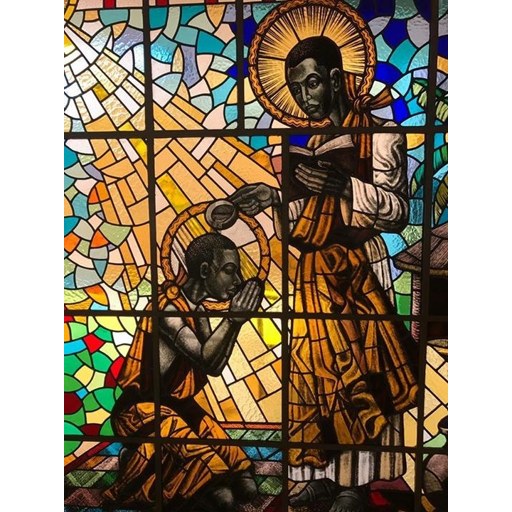
Wulman83
License: CC BY-SA 4.0
Saint Kizito
Saint- Life Span
- 1872 - 1886 (age 14)
- Feast Day
- 3 June
- Gender
- male
- Church
- Catholic
Places
Roles & Family
Patronage
children
Canonization
Biography
Saint Kizito was the youngest of the Catholic Uganda Martyrs, the group of twenty-two Catholics put to death for their faith in the Kingdom of Buganda in 1885–1886. He was a Muganda boy, born about 1872 in Buganda in what is now Uganda, and while still a child he entered the royal enclosure as a page at the court of Kabaka Mwanga II. There he came under the care of older Christian pages, above all Charles Lwanga, who as head of the royal pages instructed the younger boys in the Catholic faith. Kizito became a catechumen, learning the faith both from the Christian pages and from the Missionaries of Africa (the White Fathers), who had a mission near the capital. He was not a member of a religious order; he remained a lay court page until his death.
Life at Mwanga’s court grew increasingly dangerous for Christians. The kabaka came to see the new religion as a challenge to his authority and to customary royal privileges, and he also resented the pages’ refusal to submit to his sexual demands. Lwanga took special care to shield the youngest boys, including Kizito, from the king. In May 1886 Mwanga’s hostility broke into open persecution after pages were found to have gone for Christian instruction. The Christian pages were seized. On the night of 25–26 May 1886, knowing that execution was likely, Charles Lwanga privately baptized Kizito and several other catechumens, among them Mbaga Tuzinde, Gyavira, and Mugagga.
The condemned were marched some sixteen miles to Namugongo, the traditional place of execution. On 3 June 1886 they were wrapped in reed mats and burned alive. Missionary reports and later testimony gathered for the beatification process describe Kizito, then about fourteen, as going to his death with unusual cheerfulness and courage. Lwanga was killed separately at Namugongo the same day. Because the victims were burned, no conventional burial is recorded; the site of the executions is today marked by the Basilica of the Uganda Martyrs at Namugongo, a major pilgrimage church.
The twenty-two Catholic martyrs were beatified by Pope Benedict XV on 6 June 1920 and canonized by Pope Paul VI on 18 October 1964. Their common feast is kept on 3 June. Kizito’s youth and the accounts of his joy in martyrdom have made him a particular focus of devotion among children and young people in Uganda and elsewhere in East Africa, and many schools, parishes, and youth groups bear his name.