Saint Laura of Constantinople is a saint of the Catholic Church (d. 1453).
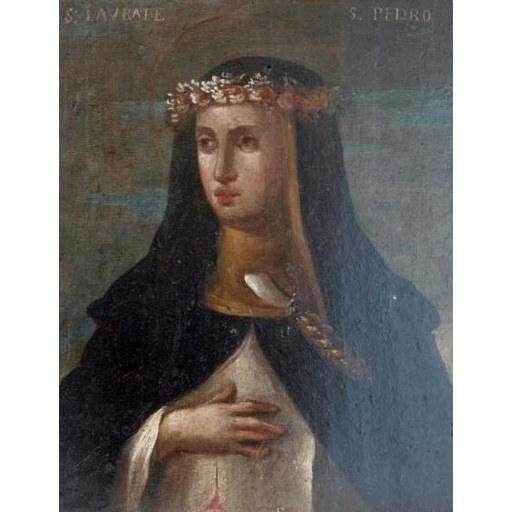
Pedrohuerta
License: CC BY-SA 3.0
Saint Laura of Constantinople
Saint- Life Span
- d. 1453
- Gender
- female
- Church
- Catholic
Places
Roles & Family
Biography
Saint Laura of Constantinople is an obscure Christian saint whose memory is preserved chiefly in later hagiographical notices rather than in contemporary Byzantine historiography. Tradition places her birth in Constantinople, the imperial capital of the Byzantine Empire, and situates her life in the last generations before the city’s fall. No reliable source records the year of her birth, the names of her parents, or the social rank of her family, although some modern compilations describe her as being of noble origin—an assertion that cannot be independently confirmed and that belongs to a common pattern in saintly vitae. Equally unknown are the circumstances under which she embraced the monastic life. Later accounts simply state that she became a nun in Constantinople and in time was chosen abbess of a convent in the city. A number of secondary sources identify that house as a monastery of Saint Theodosius; the identification is not corroborated by surviving Byzantine typika or archival lists of Constantinopolitan convents and should be treated as unverified.
The event with which her cult is invariably linked is the Ottoman conquest of Constantinople in 1453. After a siege of several weeks, the army of Sultan Mehmed II breached the Theodosian Walls on 29 May 1453. The capture of the city was accompanied by killing, enslavement, and the desecration of churches, as recorded by eyewitnesses such as George Sphrantzes and by later historians. Within this setting, pious tradition asserts that Abbess Laura and the nuns of her community were taken by Ottoman soldiers and put to death, some versions specifying that they were burned alive. No known fifteenth-century Greek, Latin, or Ottoman narrative names Laura or describes the destruction of a convent of Saint Theodosius in these terms. The story therefore stands as a hagiographical commemoration of the religious victims of the sack rather than as a documented episode.
Because the evidence is so thin, Laura of Constantinople is easily confused with other holy women of the same name, above all Saint Laura of Córdoba, a ninth-century abbess in Islamic Spain who was martyred by scalding and whose feast is kept on 19 October. The two figures belong to different centuries, regions, and political contexts; conflation of their stories in popular saint directories has added to the uncertainty surrounding the Constantinopolitan Laura. There is no securely attested burial place, no surviving relic tradition of clear medieval or early modern provenance, and no record of a formal process of canonization or beatification by a pope or by an Orthodox synod. Any veneration she has received appears to rest on local or popular listing among the martyrs associated with 1453.
In modern martyrologies and online calendars she is occasionally assigned a feast day, most often in the spring, but these dates are not consistent and do not rest on an ancient liturgical witness comparable to those of the great Constantinopolitan saints. She is not known to have been a pope or a patriarch, nor is there documentation that she married or had children; the only role consistently attributed to her is that of abbess and martyr. Patronages of places, professions, or causes are not recorded in standard hagiographical reference works. For the historian, Saint Laura of Constantinople remains a shadowy figure: a name attached to the memory of monastic women who perished or were enslaved when the Byzantine capital fell, rather than a biography that can be reconstructed in detail from reliable sources.