Saint Ludmila of Bohemia is a saint of the Catholic Church (d. 921). Saint Ludmila of Bohemia's feast day is celebrated on 16 September. Saint Ludmila of Bohemia is the patron saint of Bohemia;Czech Republic;converts;widows;duchesses.
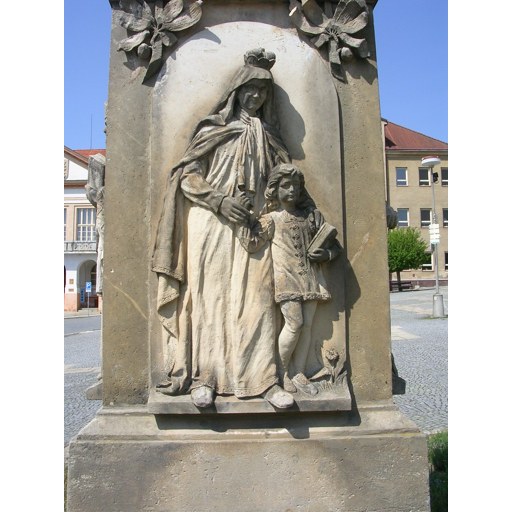
cs:ŠJů
License: CC BY-SA 3.0
Saint Ludmila of Bohemia
Saint- Life Span
- d. 921
- Feast Day
- 16 September
- Gender
- female
- Church
- Catholic
Places
Relics & Where to Venerate
Location unknown
The bodily remains of Saint Ludmila of Bohemia are a first-class relic. Venerated at St. George's Basilica.
Roles & Family
Religious Information
Patronage
Bohemia;Czech Republic;converts;widows;duchesses
Biography
Saint Ludmila of Bohemia was a duchess of the early Přemyslid house and is remembered as one of the first documented Christians among the Czech nobility and as the grandmother of Saint Wenceslaus. Traditional Bohemian narratives, above all the tenth-century work known as Christian's Legend, present her as the daughter of Slavibor, a prince of the Pšovan people whose stronghold is identified with Mělník. In the later ninth century she was married to Bořivoj I, the first historically attested duke of Bohemia. According to the same tradition, the couple received baptism from Saint Methodius, the Byzantine missionary and archbishop associated with Great Moravia, at a time when Christian teaching was moving from Moravia into Bohemia. Their conversion placed the ducal household among the earliest recorded Christians in the Czech lands and tied the Přemyslid court to the Slavonic mission.
As duchess, Ludmila supported the introduction of Christian worship at a still largely pagan court. Bořivoj is credited with founding a church dedicated to the Virgin Mary at Prague Castle, and the couple's patronage helped establish clergy and churches in Bohemia. They had several children, of whom two sons, Spytihněv I and Vratislaus I, later ruled as dukes. After Bořivoj's death toward the end of the ninth century, Ludmila lived as a widow of notable piety and continued to exercise influence within the dynasty. When Vratislaus died in 921, his son Wenceslaus was still a minor. Ludmila, as grandmother, took a leading part in the boy's Christian upbringing and in the regency. That role brought her into open conflict with Wenceslaus's mother, Drahomíra of the Stodorane, who headed a faction at court less committed to Ludmila's authority and to the new religion.
The struggle ended in her murder. Drahomíra is reported to have employed two noblemen, named in the legends as Tunna and Gommon, who went to Ludmila's residence at Tetín Castle and strangled her with her own veil on 15 September 921. The manner of death became a fixed feature of her iconography. She was first buried at Tetín, in a church later associated with Saint Michael. Within a few years her grandson Wenceslaus, once he had assumed power, had her remains translated to the Basilica of Saint George at Prague Castle. There a cult of the martyred duchess grew beside the princely necropolis, and her tomb became a focus of Bohemian devotion.
Ludmila's veneration spread with the cult of Saint Wenceslaus and became part of the religious identity of medieval Bohemia. She is commemorated on 16 September in both the Roman Catholic and Eastern Orthodox calendars. Later tradition numbered her among the principal patrons of Bohemia and of the Czech lands; she has also been invoked as a patron of converts, of widows, and of duchesses. Her story, preserved in Latin and Church Slavonic legends of the tenth and eleventh centuries, presents her as a foundress of Bohemian Christianity whose death at the hands of a hostile court faction made her the country's first widely honored female martyr. Relics associated with her have remained at Saint George's Basilica in Prague, and her image—often shown with a veil, a palm of martyrdom, or the young Wenceslaus—has been a staple of Czech sacred art from the Middle Ages onward.