Saint Lüfthildis is a saint of the Catholic Church. Saint Lüfthildis's feast day is celebrated on 23 January. Saint Lüfthildis is the patron saint of Lüftelberg;eye diseases.
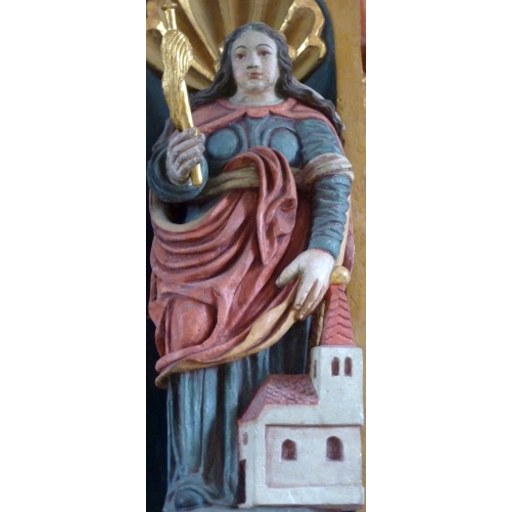
https://catholicsaints.info/saint-lufthild
License: unknown
Saint Lüfthildis
Saint- Feast Day
- 23 January
- Gender
- female
- Church
- Catholic
Places
Roles & Family
Patronage
Lüftelberg;eye diseases
Biography
Saint Lüfthildis, also known as Lufthildis, Lüfthild, or Liuthild, is a ninth-century German recluse whose cult is centered on the village of Lüftelberg, now a district of Meckenheim in the Rhineland south of Bonn. Virtually no contemporary written record of her life survives. What is known derives from later medieval tradition, from the toponym Lüftelberg itself, understood as the hill of Lüfthildis, and from the continuous local veneration of her relics in the parish church of St. Petrus in Ketten. Historians generally accept that a holy woman of that name lived as a hermit in the forested upland of the region during the Carolingian era, most often placed in the mid-ninth century, but they treat the narrative details of her biography as legendary accretions typical of female eremitical saints.
Later hagiographic accounts describe her as the daughter of a noble Frankish family. From an early age she is said to have been drawn to prayer, fasting, and works of charity. Family members, in some versions a stepmother, opposed her desire for a consecrated life and attempted to arrange a marriage. Lüfthildis fled or was driven from home and established a solitary hermitage in the woods. There she passed her remaining years in poverty, manual labor, and contemplation. Popular legend credits her with miracles of healing already during her lifetime and with a reputation for holiness that drew visitors even before her death. None of these episodes can be corroborated by independent ninth-century sources; they follow well-known patterns in the lives of early medieval recluses.
After her death she was buried at the site of her hermitage. A church was later built over or near her grave, and her relics became the focus of pilgrimage. The present parish church of St. Petrus in Ketten in Lüftelberg preserves her remains and has been the principal sanctuary of her cult for centuries. A spring associated with her name was long visited by the sick, especially those suffering from ailments of the eyes; in local devotion she has therefore been invoked against eye diseases and headaches. Her feast day is observed on 23 January, particularly in the Archdiocese of Cologne. She was never formally canonized by a pope according to the later juridical process; her status rests on immemorial public veneration, a pattern common for many regional saints of the early Middle Ages.
The historical Lüfthildis thus stands at the intersection of sparse fact and rich local memory. She belongs to a wider phenomenon of Carolingian and post-Carolingian female recluses who lived on the margins of monastic institutions or in forest hermitages and whose tombs generated parish cults. While the precise years of her birth and death, her parentage, and the concrete events of her life remain unknown, the endurance of her name in the landscape, the presence of her relics, and the liturgical commemoration on 23 January constitute the verifiable core of her story. Modern scholarship therefore regards her as an authentic, if obscure, holy woman of the ninth-century Rhineland whose legend was elaborated in subsequent centuries to meet the needs of local piety.