Saint Marcian of Syracuse is a saint of the Catholic Church. Saint Marcian of Syracuse's feast day is celebrated on 14 June. Saint Marcian of Syracuse is the patron saint of Syracuse.
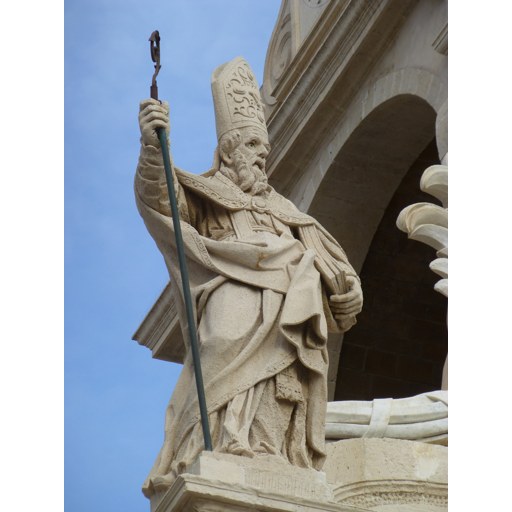
amercader
License: CC BY-SA 2.0
Saint Marcian of Syracuse
Saint- Feast Day
- 14 June
- Gender
- male
- Church
- Catholic
Places
Relics & Where to Venerate
Location unknown
Marcian's body was kept inside the crypt dedicated to the saint, later overlooked by the Byzantine-era basilica
Housed at Messina Cathedral · Italy
However, some of the saint's relics remained in Syracuse, and the city's cathedral housed the reliquary of St Marcian's arm, which was later donated in the 12th century by the English bishop Richard Palmer, then head of the church of Syracuse, to the treasury of the cathedral of Messina, its final destination
Housed at Cathedral of Syracuse · Cathedral Square, Italy
However, some of the saint's relics remained in Syracuse, and the city's cathedral housed the reliquary of St Marcian's arm, which was later donated in the 12th century by the English bishop Richard Palmer, then head of the church of Syracuse, to the treasury of the cathedral of Messina, its final destination
Roles & Family
Patronage
Syracuse
Biography
Saint Marcian of Syracuse, also known as Marcianus or, in Italian, San Marciano di Siracusa, is venerated in the Catholic and Eastern Christian traditions as a bishop and martyr and is traditionally regarded as the first bishop of Syracuse in Sicily. According to the account preserved in the Roman Martyrology and in later Sicilian hagiography, he was a disciple of the Apostle Peter, who sent him to preach the Gospel in Sicily. Local tradition therefore presents Syracuse as one of the earliest centres of Christianity in the Latin West. These claims rest on late legendary vitae and on liturgical commemoration rather than on contemporary historical records, and modern scholarship treats a first-century episcopate at Syracuse as unverified, even while acknowledging the antiquity of Marcian’s cult in the city.
The legendary narrative of his ministry places him in Syracuse, where he is said to have gathered a Christian community and to have used as a place of worship a site later identified with the Crypt of San Marciano. That crypt lies beneath the Basilica of San Giovanni Evangelista, adjacent to the extensive catacombs of San Giovanni on the outskirts of ancient Syracuse. Tradition identifies the crypt as both an early Christian place of worship in the city and the burial place of the proto-bishop. Archaeology shows that the catacombs themselves developed as a major Christian cemetery from about the third century, which is consistent with a flourishing church by late antiquity but does not independently confirm a Petrine-era foundation. Episcopal lists of Syracuse nonetheless begin with Marcian, and his name remained central to the city’s Christian self-understanding.
Accounts of his death vary in detail but agree in presenting him as a martyr. The Roman Martyrology commemorates him on 14 June as a bishop ordained by Saint Peter and killed by Jews after he had preached the Gospel. Other versions of the legend describe pagan persecution or a violent death such as being cast from a tower. A traditional date in the reign of Nero, often given as about the year 68, belongs to this pious chronology and is not corroborated by independent evidence. Occasional later notices that assign him to the third century appear to reflect confusion with other figures or with the period from which the earliest material remains of Syracusan Christianity actually survive. In the absence of contemporary documentation, the historical circumstances of his life and death cannot be established with precision.
The cult of Saint Marcian is nonetheless of long standing in Syracuse. He has been honored as proto-bishop and as a patron of the city, together with Saint Lucy, who became the principal patroness of Syracuse after her martyrdom in the early fourth century. The crypt that bears Marcian’s name continued to be a place of pilgrimage and liturgical memory. In the Roman Catholic Church his feast is kept on 14 June; Eastern calendars have also commemorated him, sometimes on other dates. Whatever the legendary accretions surrounding his biography, Marcian remains the emblematic founder-saint of the Syracusan church, and his figure illustrates how early Sicilian Christianity remembered its origins through the memory of a Petrine disciple and martyr-bishop.