Saint Ninfa is a saint of the Catholic Church. Saint Ninfa's feast day is celebrated on 10 November. Saint Ninfa is the patron saint of Palermo;Santa Ninfa.
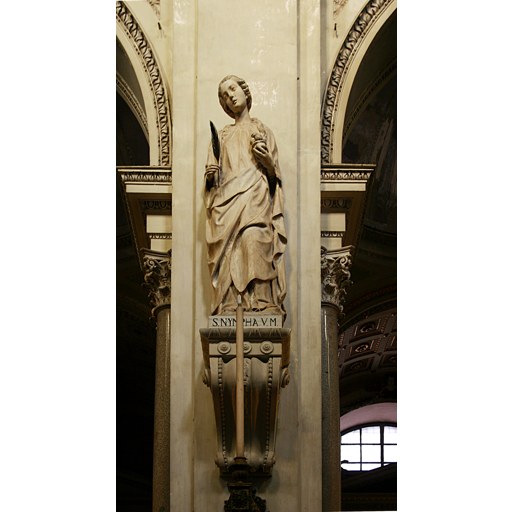
José Luiz
License: CC BY-SA 4.0
Saint Ninfa
Saint- Feast Day
- 10 November
- Gender
- female
- Church
- Catholic
Places
Roles & Family
Patronage
Palermo;Santa Ninfa
Biography
Saint Ninfa, known in Latin as Nympha and in Italian as Santa Ninfa, is a Christian virgin saint whose historical life is poorly documented and whose surviving biographies are late and legendary. She is associated above all with Palermo in Sicily. The Roman Martyrology records her on 10 November with the notice of Saint Nympha, virgin, at Palermo in Sicily, a formula that indicates the principal place of her cult rather than a fully verified biography. Scholars generally place her in the late antique period, most often in the third, fourth, or fifth century, but no contemporary chronicle or inscription supplies a birth year, a death year, or an independent narrative of her career. The personal name Nympha was in use among Christians in the Roman world and should not be confused with purely mythological nymphs.
Later Sicilian and Roman legends offer several, not always compatible, accounts of her life. In the Palermitan tradition she was born at Palermo of a respectable or noble family and dedicated herself to Christ as a virgin. One version states that during a persecution—sometimes identified with that of Decius or Diocletian, sometimes with the Vandal occupation of Sicily in the fifth century—she left the island and crossed to the Italian mainland, where she died of fever, at Savona according to some tellings or in the neighborhood of Porto according to others. A second version holds that she was put to death for the faith in Palermo itself. A third strand, reflected in medieval Roman liturgical books, links her with Saints Tryphon and Respicius, whose feast was long kept on 10 November; in that grouping Nympha appears as a virgin from Palermo who came to Rome. Critical hagiographers, including the Bollandists, have regarded these stories as unhistorical in their details and have treated the possible identity of the Palermitan Nympha with the companion of Tryphon as uncertain.
Whatever the facts of her life, the cult of Saint Ninfa in Palermo is old. Relics attributed to her are preserved in the Cathedral of the Assumption (the Duomo) of Palermo, where she is venerated together with Saints Agatha, Christina, and Olivia as one of the four ancient virgin patronesses of the city. After the plague of 1624 Saint Rosalia became the principal patron of Palermo, but Ninfa retained her place among the co-patronesses. The church of Santa Ninfa dei Crociferi in Palermo testifies to her local importance. In 1605 a new settlement in the Belice valley, in what is now the province of Trapani, was founded and named Santa Ninfa in her honor; she is the patron saint of that town. No reliable early source establishes further patronages of trades, illnesses, or other causes.
Saint Ninfa held no papal or patriarchal office and belonged to no later religious order. The martyrological title of virgin indicates that she was remembered as a woman who did not marry; no source of any authority assigns her a husband or children. Her recognition as a saint belongs to the era of popular cult and episcopal approbation, long before the centralized papal canonization process of the later Middle Ages, so neither a canonizing pope nor a beatifying pope can be named. The liturgical commemoration on 10 November remains the principal date in the Roman Martyrology. Because the evidence is so limited, a careful historian can affirm the existence of an early cult of a virgin named Nympha at Palermo and the subsequent spread of her name in Sicily, while remaining silent on almost every biographical particular.