Saint Pammachius is a saint of the Catholic Church (d. 409). Saint Pammachius's feast day is celebrated on 30 August.
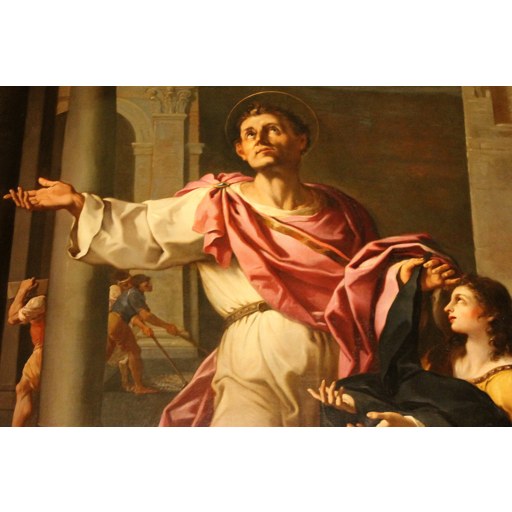
Alekjds
License: CC BY-SA 4.0
Saint Pammachius
Saint- Life Span
- d. 409
- Feast Day
- 30 August
- Gender
- male
- Church
- Catholic
Places
Roles & Family
Religious Information
Biography
Saint Pammachius was a Roman senator of the later fourth and early fifth centuries, drawn from the Christian senatorial aristocracy of the city of Rome and customarily associated with the noble gens Furia. He was a schoolfellow and lifelong friend of Eusebius Hieronymus, later known as Saint Jerome; their surviving correspondence and Jerome’s dedications of biblical commentaries to him are the principal contemporary sources for his life, learning, and piety. Educated in the classical manner usual to his class, he combined the public standing of a senator with an increasingly serious Christian commitment at a time when the western imperial elite was still negotiating the demands of official Christianity and the new ascetic ideal.
He married Paulina, the second daughter of Saint Paula of Rome, thereby uniting two of the most prominent Christian houses of the Roman aristocracy. Paulina died in 397. Jerome’s Letter 66, a lengthy consolation addressed to Pammachius, records the loss, praises Paulina’s virtue, and urges her husband to persevere in charity and sacred study. After her death Pammachius adopted a life of rigorous self-denial while remaining in Rome rather than withdrawing to a desert community. Contemporaries described his manner of life as monastic. He distributed a large part of his fortune to the poor and devoted himself to scriptural learning as a layman of high rank.
Together with the Roman matron Fabiola, another correspondent of Jerome, Pammachius founded a xenodochium, or hospice for pilgrims, travellers, and the sick, at Portus Romanus near Ostia. The foundation is among the earliest documented institutions of its kind in the Latin West; nineteenth-century excavations at Porto uncovered buildings and mosaic pavements that have been connected with the site. Pammachius is also associated with the conversion of family property on the Caelian Hill into a Christian place of worship, the titulus Pammachii, identified with the later basilica of Santi Giovanni e Paolo, built over an earlier Roman house linked by tradition to the martyrs John and Paul.
Pammachius took a notable part in the theological disputes of his generation, especially the controversy over Origen. In the late 390s he and his friend Oceanus wrote to Jerome requesting an account of Rufinus of Aquileia’s Latin version of Origen’s On First Principles. Jerome’s replies, together with his Apology against Rufinus and several commentaries on the Minor Prophets and on Daniel dedicated to Pammachius, show him acting as an informed and relatively irenic lay patron who sought both doctrinal clarity and, so far as possible, peace among the disputants. He died in Rome in 409, shortly before Alaric’s Goths captured the city in 410. His name entered the martyrologies at an early date, and his feast has long been observed on 30 August in the Roman calendar.