Saint Patrick is a saint of the Pre-Schism (Universal) Church. Saint Patrick's feast day is celebrated on 17 March. Saint Patrick is the patron saint of Ireland;Nigeria;Montserrat;engineers;paralegals;Archdiocese of New York;Archdiocese of Boston;Melbourne;Adelaide;Auckland.
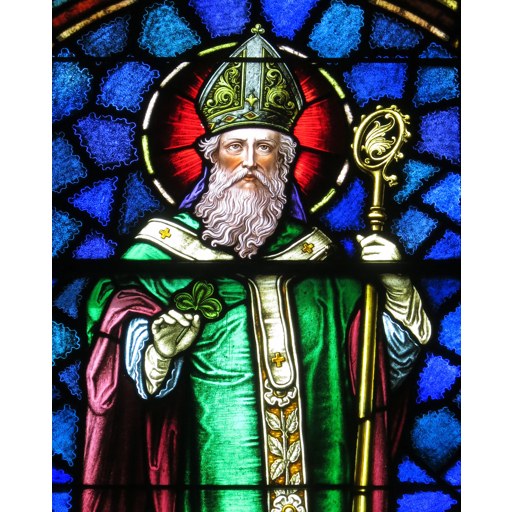
Nheyob
License: CC BY-SA 4.0
Saint Patrick
Saint- Feast Day
- 17 March
- Gender
- male
- Church
- Pre-Schism (Universal)
Places
Sacred Places


Roles & Family
Patronage
Ireland;Nigeria;Montserrat;engineers;paralegals;Archdiocese of New York;Archdiocese of Boston;Melbourne;Adelaide;Auckland
Biography
Saint Patrick (Latin: Patricius) was a fifth-century Romano-British Christian missionary and bishop in Ireland, later venerated as the Apostle of Ireland and that island’s principal patron saint. Nearly all historically reliable information about him comes from two short Latin works generally accepted as authentic: the Confessio, written late in life as a spiritual autobiography and defense of his mission, and the Epistola, a letter of rebuke to the soldiers of the British chieftain Coroticus. Patrick records that he was born in Roman Britain, the son of Calpurnius, a decurion (town councillor) who was also a deacon, and the grandson of the priest Potitus. He names his birthplace Bannavem Taburniae (also given as Bannaventa Berniae), a site that has never been identified with certainty despite many proposed locations in western Britain. At the age of sixteen he was seized in a raid by Irish pirates, carried across the sea, and enslaved in Ireland for six years, during which he herded livestock and underwent a profound religious conversion, praying constantly by day and night.
A dream instructed him that a ship was ready; he escaped, traveled a great distance to a port, and after further trials, including a period of near starvation, returned to his family in Britain. There he received a vision of a man named Victoricus bringing letters from Ireland, and he heard the voice of the Irish beside the Wood of Foclut calling him to walk once more among them. Despite the opposition of some elders who recalled a sin of his youth, he pursued clerical training. Later tradition, not found in his own writings, places this formation in Gaul, often at Auxerre under Bishop Germanus. Ordained a bishop, he returned to Ireland, most probably in the middle decades of the fifth century, to preach, baptize, and ordain clergy, concentrating his work in the north and west among communities still largely pagan rather than in the already partly Christianized south and east.
His mission involved both notable success and serious hardship. He claims to have baptized many thousands and to have established churches and clergy, yet he also mentions imprisonment, threats, and a deliberate refusal of gifts from kings so that his motives could not be questioned. The letter to Coroticus condemns the massacre and enslavement of newly baptized Irish Christians, still in their white garments, by a British raiding party, and shows Patrick identifying himself fully with his Irish flock. In the Confessio he answers accusations that he had sought the episcopate for profit or had mishandled funds, insisting that he had come to Ireland only in obedience to a divine call and had spent himself without seeking earthly reward. He writes in a Latin he himself describes as rustic and unpolished, yet the text is densely woven with biblical quotation and allusion.
Neither the year nor the precise circumstances of his death are recorded by contemporary witnesses. Later Irish annalistic traditions offer competing dates, most often 461 or 493, while seventh-century hagiographers such as Muirchú placed his death at Saul in County Down and his burial at nearby Downpatrick, where a traditional grave is still shown. Patrick was never formally canonized under later papal procedures, having lived in the age of local cults; his feast on 17 March is attested from the early Middle Ages and became a major celebration in Ireland and among the Irish diaspora. Subsequent medieval lives added miracle stories, including the legendary expulsion of snakes from Ireland and the use of the shamrock to explain the Trinity. These legends, together with the authentic writings, established him as the central figure of Irish Christian identity, venerated in the Catholic, Eastern Orthodox, Anglican, and Lutheran traditions, and invoked as patron of Ireland, of Nigeria, of Montserrat, of engineers and paralegals, and of numerous dioceses and cities with Irish connections.