Saint Perpetuus is a saint of the Catholic Church (d. 490). Saint Perpetuus's feast day is celebrated on 8 April.
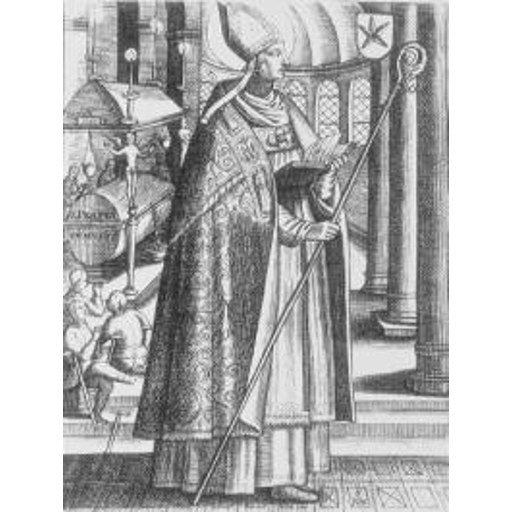
Unknown authorUnknown author
License: Public domain
Saint Perpetuus
Saint- Life Span
- d. 490
- Feast Day
- 8 April
- Gender
- male
- Church
- Catholic
Places
Roles & Family
Biography
Saint Perpetuus was a Gallo-Roman prelate of senatorial rank who served as Bishop of Tours in the later fifth century. The principal near-contemporary witness to his life is Gregory of Tours, writing in the sixth century, who presented Perpetuus as a kinsman of earlier bishops of the see and of Gregory’s own family. Perpetuus succeeded Bishop Eustochius around 460 or 461 and held the see for about thirty years. In the succession given by Gregory he is the sixth bishop of Tours, after Gatianus, Litorius, Martin, Brice, and Eustochius. No reliable source records his year or place of birth, and nothing certain is known of any marriage or children.
The work for which he is best remembered is the rebuilding of the shrine of Saint Martin of Tours. Perpetuus replaced the small chapel over Martin’s tomb with a large basilica, which Gregory later described in some detail (about 160 feet in length and 60 in breadth, with numerous windows in nave and sanctuary). The church was dedicated in the 470s. Perpetuus had it furnished with inscriptions and is associated with the poet Paulinus of Périgueux, who recast Sulpicius Severus’s Life of Martin in hexameter verse at the bishop’s request. He also fixed the diocesan observance of Martin’s feasts—11 November (burial) and 4 July (a translation)—with vigils and processions, thereby giving lasting shape to Martin’s cult in the Touraine.
Sources further credit Perpetuus with other churches in the region, including dedications to Saints Peter and Paul and to Saint Maurice, and with a rule of life for the clerics who served the basilica of Saint Martin. A testament circulated under his name, known from early medieval copies, disposes of villas and revenues in favour of the churches of Tours. Modern historians treat the surviving text with caution and do not agree on its full authenticity, but they accept that Perpetuus was a substantial landowner of the Gallo-Roman aristocracy that still supplied many bishops in fifth-century Gaul. He is also said to have prescribed weekly fasts on Wednesday and Friday and to have ordered the liturgical year of the diocese with some care.
He died in Tours at the end of the fifth century. Gregory’s figure of a thirty-year episcopate points to a death about 490; later tradition gives 30 December 490, while some martyrologies and older Catholic reference works give 8 April 491. He was buried in the basilica of Saint Martin that he had built. His successor was Volusianus, another member of the same senatorial connection. Veneration of Perpetuus appears already in the Martyrologium Hieronymianum and in Gregory of Tours. The Roman Martyrology commemorates him on 8 April. He belongs to the age of local, pre-congregational cultus and was not the object of a later papal canonization. No well-attested patronages are attached to his name.