Saint Regulus is a saint of the Catholic Church. Saint Regulus's feast day is celebrated on 17 October.
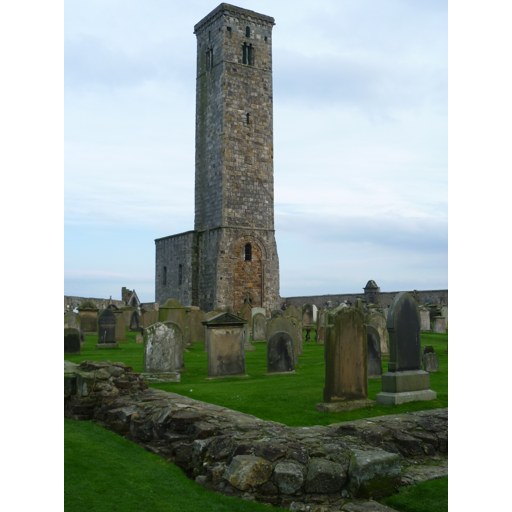
Kim Traynor
License: CC BY-SA 3.0
Saint Regulus
Saint- Feast Day
- 17 October
- Gender
- male
- Church
- Catholic
Places
Roles & Family
Biography
Saint Regulus, also known in Scottish tradition as Saint Rule (Latin Sanctus Regulus; associated in some Irish sources with the name Riagal or Riagail), is a figure of early medieval Christian legend rather than of securely documented history. In the foundation story of the church of St Andrews in Fife, he is presented as a monk or, in some tellings, a bishop attached to the church of Patras in Achaea, where the relics of the Apostle Andrew were said to have been kept. The tale belongs to the cult of Saint Andrew in eastern Scotland and is preserved in medieval Scottish sources, notably versions of the St Andrews foundation legend circulating by the twelfth century, rather than in contemporary fourth-century Greek or Roman records. No reliable source supplies a birth year, a birthplace distinct from his legendary association with Patras, or an independently attested career.
According to the legend, when the emperor Constantine intended to remove Andrew’s relics from Patras to Constantinople, an angel warned Regulus in a vision to take a portion of the bones and carry them to the far northwest, to a place that would be revealed to him. He is said to have taken a small set of relics—commonly listed as a tooth, a kneecap, an upper arm bone, and fingers—and to have sailed westward until he was wrecked on the coast of Pictish Fife, at a site later identified with Kilrymont (Cennrígmonaid), which became St Andrews. There he is described as having been received by a Pictish king named Hungus or Óengus and as having built a church to house the apostle’s remains. The story exists in more than one recension; later medieval versions struggle to reconcile a Constantinian, fourth-century setting with a king whose name matches historically attested Pictish rulers of the eighth century, a chronological tension that modern historians treat as evidence that the narrative was shaped long after the events it claims to describe.
Scholars generally regard the Greek voyage as a prestige legend constructed to give the bishopric of St Andrews an apostolic relic and an exotic origin, comparable to other western foundation stories that link local churches to the apostolic age. The cult of Andrew at Kilrymont is historically visible from the eighth century onward, and the arrival of relics has been associated by some historians with Northumbrian or other Insular transmissions rather than with a fourth-century Greek monk. A further complication is the Irish saint Riagail of Muicinis (Mucinis), commemorated in Irish martyrologies around mid-October; the closeness of name and feast has led to the suggestion that an Insular holy man was later recast as a Greek custodian of Andrew’s bones. Whether Regulus was a historical person at all, and if so whether he was Greek, Irish, or Pictish, cannot be established from surviving evidence.
Liturgically he was honoured in Scotland: the Aberdeen Breviary assigns him a feast on 17 October. The Romanesque St Rule’s Tower (St Regulus’ Tower) beside the cathedral ruins at St Andrews preserves his name in the local landscape, though the standing fabric is many centuries later than the legendary saint and does not constitute archaeological proof of his burial or of a fourth-century church. He was not Bishop of Rome, nor a patriarch of an Eastern see, and no medieval source records a spouse or children; the tradition uniformly presents him as a monk. Beyond the St Andrews legend and the October feast, there is no well-documented list of patronages, and the dates of any formal canonization or beatification are unknown, as is typical of saints whose cults arose by local acclaim before the later centralized processes of the Latin Church.