Saint Sané is a saint of the Catholic Church. Saint Sané is the patron saint of Plouzané.
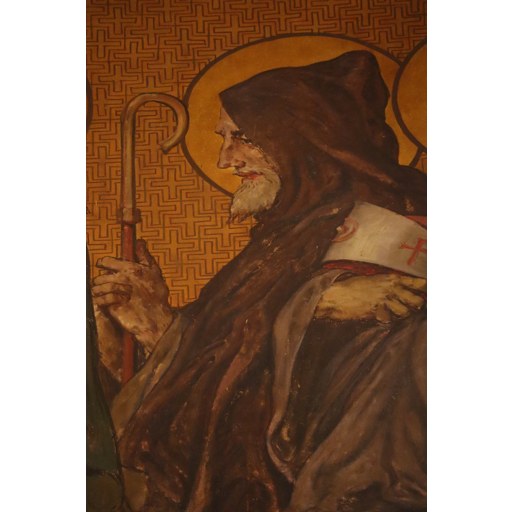
GO69
License: CC BY-SA 4.0
Saint Sané
Saint- Gender
- male
- Church
- Catholic
Places
Roles & Family
Patronage
Plouzané
Biography
Saint Sané is an obscure Breton saint whose cult is centered on the parish of Plouzané in the historic region of Léon, in western Brittany (present-day Finistère, France). He is conventionally placed in the sixth century, the era of the principal British migrations into Armorica and of the foundation of many of the earliest Breton parishes. Almost nothing about his life can be established from contemporary or even near-contemporary written sources. His existence as a historical figure is inferred chiefly from toponymy: the Breton place-name Plouzané is formed from ploe (parish) and the personal name Sané, indicating that a holy man of that name was remembered as the founder or patron of the original ecclesiastical settlement.
Local tradition, which cannot be traced to any early vita, presents Sané as a companion or disciple of Saint Pol Aurélien (Paul Aurelian), the missionary bishop credited with evangelizing the Léon peninsula and establishing the see of Saint-Pol-de-Léon. Like Pol and many other Breton founder-saints, Sané is often presumed to have been of insular British origin, yet no medieval text actually records his birthplace, parentage, or the circumstances of any crossing from Britain to the Continent. He is said to have settled in the coastal district west of Brest, where a religious community associated with him later developed into the parish of Plouzané. The parish church of Plouzané remains dedicated to him.
No medieval life of Saint Sané has survived, and he is mentioned only cursorily, if at all, in the principal early-modern compilations of Breton hagiography, including Albert Le Grand’s Les Vies des saints de la Bretagne Armorique (1637). Consequently the details routinely supplied for better-documented saints—precise dates of birth and death, names of parents or teachers, accounts of miracles, and the place of burial—are entirely lacking. It is not even certain whether Sané was a bishop, an abbot, a simple priest, or a hermit. The Celtic churches of the sixth century frequently combined eremitical and pastoral roles, and many parish founders were monks, but this remains an inference rather than a documented fact in Sané’s case.
His cult appears to have remained strictly local. Apart from the church of Plouzané itself, few other dedications are securely recorded. He was never the object of a formal process of canonization or beatification at Rome; like the great majority of early Breton saints he was venerated by popular acclaim and diocesan recognition. Modern liturgical calendars of the diocese of Quimper sometimes include his name, but even the date of his feast is not uniformly or anciently attested. No patronage beyond the parish of Plouzané itself is documented in reliable sources. In the absence of a trustworthy vita, the historian can say little more than that a holy man named Sané was remembered as the founder of one of the ancient parishes of Léon and that his memory was preserved in the place-name and in the dedication of the parish church.