Saint Sarah is a saint of the Catholic Church. Saint Sarah's feast day is celebrated on 24 May. Saint Sarah is the patron saint of Romani people.
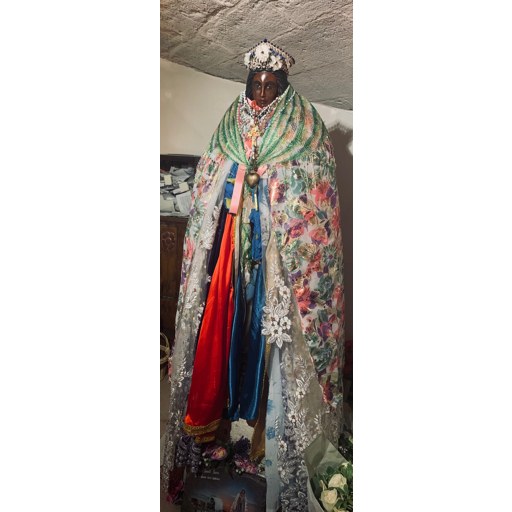
France-Pt9301
License: CC BY-SA 4.0
Saint Sarah
Saint- Feast Day
- 24 May
- Gender
- female
- Church
- Catholic
Places
Roles & Family
Patronage
Romani people
Biography
Saint Sarah, known among the Roma as Sara e Kali and in French devotion as Sara-la-Kali or Sara la Noire, is a figure of popular Christian veneration whose existence is not attested in the New Testament, in patristic literature, or in any early medieval source from Gaul. She is honoured principally at Saintes-Maries-de-la-Mer in the Camargue, in southern France, where a dark-skinned statue kept in the crypt of the parish church has long been identified with her. Romani, Sinti, and related communities regard her as their patron saint, and the gathering held there in late May is among the most important religious assemblies in the Romani Catholic world. Historians of hagiography classify her as a legendary or folkloric saint: the stories that give her a first-century life cannot be verified and appear in written form only at a late date.
The legends that place her in the apostolic age survive in several conflicting versions. The core Provençal tradition holds that after the Crucifixion a group of Jesus's followers, commonly named as Mary Magdalene, Mary Jacobe (Mary of Clopas), and Mary Salome, were set adrift in a boat without sails or oars and came ashore in the Camargue. In one account Sarah was the Egyptian servant of Mary Jacobe and Mary Salome and shared their voyage from the East. In another she was already living near the mouth of the Rhône, a dark-complexioned woman who went into the sea to help the travellers land and who thereafter served them. A further interpretation, current in some Roma circles, identifies Sara-la-Kali with the Hindu goddess Kali, an association that academic writers generally attribute to the Indian origin of the Romani people and to later religious syncretism rather than to a recoverable historical individual of the first century. The developed Sarah legend is usually dated to the fifteenth or sixteenth century, when local notices of the crypt statue and of a named companion of the Marys become clearer.
Cult practice is concentrated in the crypt of the fortified medieval church of Notre-Dame-de-la-Mer at Saintes-Maries-de-la-Mer. On 24 May the statue of Saint Sarah is customarily carried in procession from the crypt down to the sea and there immersed or blessed, a ceremony in which Roma pilgrims take a prominent part; 25 May is more particularly devoted to Mary Jacobe and Mary Salome, whose relics the church claims to possess. The pilgrimage expanded in the nineteenth and twentieth centuries into a large international meeting of Roma and related groups. The Catholic Church has not entered Sarah in the Roman Martyrology as a universally canonized saint, nor is she assigned a place on the general Roman calendar. Her cult remains a popular and local devotion, exercised with the practical acceptance of the parish and of the Archdiocese of Aix. She is not recorded as having held the papacy or a patriarchal see, as having belonged to a religious order, or as having had a spouse or children.
No year of birth or death, no securely documented birthplace, and no historically verified tomb can be established. Traditional statements that she was born in Egypt or that she died and was buried in the Camargue rest on the same late legends. What can be described with confidence is the function of the cult: it has supplied Romani Catholics with a recognised holy protectress and a fixed place of annual pilgrimage, while remaining nested within the older Provençal devotion to the Marys of the Gospel. Observers have also remarked on the statue's dark complexion and on the epithet Kali as points of contact with Egyptian and South Asian religious imagery, without being able to turn those observations into a factual biography.