Saint Serapia is a saint of the Catholic Church (d. 119). Saint Serapia's feast day is celebrated on September 3.
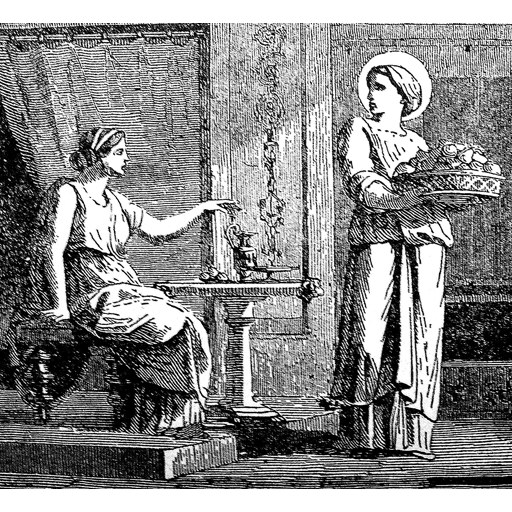
Uncertain
License: Public domain
Saint Serapia
Saint- Life Span
- d. 119
- Feast Day
- September 3
- Gender
- female
- Church
- Catholic
Places
Roles & Family
Canonization
Biography
According to Christian hagiographical tradition, Saint Serapia (also called Seraphia) was a Christian virgin and martyr of the early second century. She is said to have been born at Antioch in Syria to Christian parents toward the end of the first century. After the death of her parents, the legend relates that she distributed her goods to the poor. Either fleeing imperial persecution or having been reduced to servitude, she came to Italy and entered the household of a wealthy Roman widow named Sabina. Sources place Sabina either at Rome or at a country estate called Vindena in Umbria. Serapia served as a domestic slave or attendant and, by her example and teaching, converted Sabina to Christianity. The legendary Acts present Sabina as a woman of high rank, sometimes called the widow of a man of consular standing, and Serapia as her Syrian servant and spiritual guide.
The same Acts narrate that Serapia was accused as a Christian during the reign of the emperor Hadrian. She was brought before a magistrate named Berillus (or Beryllus). Refusing to sacrifice to the gods of Rome, she was subjected to a series of tortures that belong to the conventional repertoire of martyr literature: she was beaten with rods, mutilated, and burned with torches, yet the fire is said to have left her unharmed. She was at last beheaded with a sword. Latin martyrological tradition commonly assigns her death to the year 119, though the date is traditional rather than independently documented, and some later notices give slightly different years in the same reign. Sabina recovered the body and interred it in her family sepulchre. Not long afterward, according to the same cycle of legends, Sabina herself was denounced, tried, and put to death, and was buried beside her former servant.
In late antiquity the memory of the two women became attached to the Aventine Hill in Rome. In the fifth century a basilica, Santa Sabina, was built there by the priest Peter of Illyria (between 422 and 432); it remains one of the best-preserved early Christian churches in the city and later served as the Roman headquarters of the Dominican Order. Relics associated with Sabina and Serapia were claimed for this church, though any original burial, if historical, would have been in a private tomb rather than in the fifth-century basilica. The passio’s alternative setting at Vindena in Umbria has never been reconciled with complete certainty with the Roman cult site, and both localizations circulate in the medieval legendaries.
Modern historical criticism treats the Acts of Sabina and Serapia as largely legendary. The titulus Sabinae on the Aventine may originally have commemorated a Roman foundress or property owner named Sabina rather than a second-century martyr, with the passion narrative developing later to furnish the church with an apostolic-age saint. No contemporary documents confirm the existence, origin, or death of Serapia. Her story as transmitted in medieval legendaries and in the Roman Martyrology remains the basis of her cult. She is not associated with any religious order, which did not exist in that form in the second century, and the sources present her as a virgin without spouse or children.
Serapia is commemorated with Saint Sabina on 3 September in the Roman Martyrology, though some calendars keep Sabina on 29 August and Serapia on 3 September. She is venerated in the Roman Catholic Church and has also been honored in Eastern Christian calendars as a virgin martyr. Iconography, where it exists, typically shows her with the palm of martyrdom. No historically verified patronages of places, professions, or causes are securely attached to her name. Her cult illustrates the early Christian ideal of the faithful slave and the virgin martyr, even where the underlying biography cannot be recovered from legend.