Saint Setni is a saint of the Catholic Church.
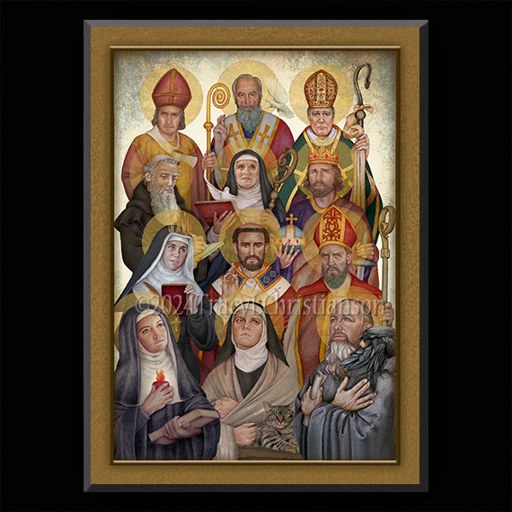
https://portraitsofsaints.com/collections/saints-icons-plaques
License: unknown
Saint Setni
Saint- Gender
- male
- Church
- Catholic
Roles & Family
Biography
Saint Setni is a figure whose historical identity is not securely established in the standard critical sources of Christian hagiography. No contemporary chronicle, dated vita, episcopal catalogue, or annalistic notice has been verified that would fix a year of birth or death, a place of origin, a place of death, or a burial site. The name may appear in local cult, calendar, or dedication traditions, but those notices have not been corroborated here against independently checkable editions of the major martyrologies or the principal hagiographical repertories. In that situation it is not legitimate to supply biographical coordinates by analogy with better-documented saints of similar name.
Obscure holy persons of this kind are well known in the medieval Christian world, especially where cult was carried by a single church, a well, a fragmentary calendar, or oral tradition rather than by a full written life. Scribal variation readily produces forms such as Setni, Sétna, Setna, and related spellings, which may denote one individual or several, and later legendaries often filled gaps with conventional monastic or missionary motifs. Without a text that can be dated and localized, claims about a particular century, region, monastery, or diocese remain conjectural and are therefore omitted.
Nothing verified indicates that Setni held the bishopric of Rome or a patriarchal or catholicosal see of the Eastern churches. There is likewise no documented evidence of a spouse, of children, or of profession in a named religious order of the later medieval type. If the figure belonged to an early monastic or eremitical milieu, that life would in any case predate the formal orders and is not proven. A universally recognized feast day, a list of patronages, and the name of a pope or other authority who canonized or beatified the saint have not been confirmed from reliable sources. Recognition of sanctity in the early and central Middle Ages was frequently liturgical and local rather than the result of a centralized Roman process.
The responsible historical course is therefore to leave the factual fields blank rather than to populate them from late folklore, uncritical compilations, or the confusion of similarly named saints. A fuller biography would require identification of a specific, datable primary witness—an early martyrology entry, a church dedication with a documented origin, or a vita that can be assessed for date and provenance. Until such evidence is produced and critically examined, Saint Setni must be treated as a name preserved in the Christian sanctoral tradition whose life and cult cannot be reconstructed in detail.