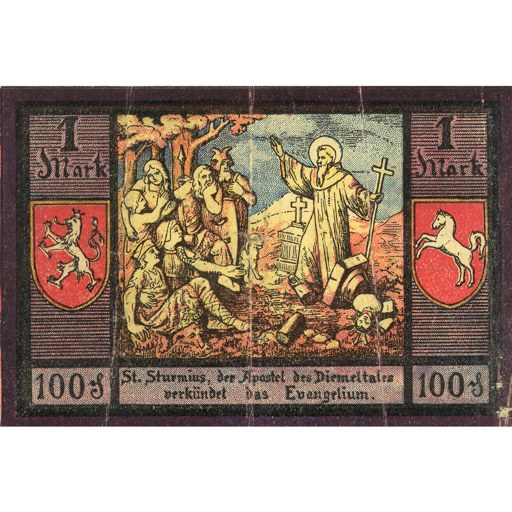
Saint Sturm is a saint of the Catholic Church (d. 779). Saint Sturm's feast day is celebrated on 17 December. Saint Sturm is the patron saint of Fulda.
Bernard Larenz
License: Public domain
Saint Sturm
Saint- Life Span
- d. 779
- Feast Day
- 17 December
- Gender
- male
- Church
- Catholic
Places
Roles & Family
Religious Information
Patronage
Fulda
Canonization
Biography
Saint Sturm, also known as Sturmi or Sturmius, was an eighth-century Benedictine monk, missionary priest, and the founding abbot of Fulda Abbey. The principal early account of his life is the Vita Sturmi, written in the early ninth century by Eigil, a later abbot of Fulda and a kinsman of Sturm. According to that source he was born of noble Christian parents in Bavaria; no contemporary text records a precise birth year or town. As a youth he was placed in the care of the Anglo-Saxon missionary Saint Boniface, then organizing the church east of the Rhine. Boniface educated him, received him as a monk, and ordained him to the priesthood. Sturm thereafter preached in Hesse and neighboring districts, working from centers associated with Boniface such as Fritzlar, and for a time lived as a hermit while searching for a suitable wilderness site for a new monastery.
Acting on Boniface’s commission, Sturm established a monastic community in 744 in the forest of Buchonia, in the valley of the river Fulda, on land granted by Carloman, mayor of the palace. The house followed the Rule of Saint Benedict and was dedicated to the Holy Saviour. To form the community more fully in Benedictine practice, Boniface sent Sturm to Italy, where he spent about a year at Monte Cassino. Fulda obtained a papal privilege of exemption from Pope Zachary, placing the abbey under the direct protection of the Holy See and outside ordinary diocesan control. After Boniface was martyred in Frisia in 754, his body was brought to Fulda, which he had chosen as his burial place, and the abbey became the chief sanctuary of his cult. Sturm, as first abbot, thus stood as Boniface’s principal monastic heir in the German lands.
Sturm’s later abbacy was marked by a jurisdictional struggle with Lull, Boniface’s successor at Mainz, who sought to bring the exempt monastery under episcopal authority. King Pepin sent Sturm into exile at the Neustrian abbey of Jumièges for about two years and imposed another superior on Fulda. The monks’ persistence and Sturm’s standing secured his restoration as abbot around the mid-760s, and Fulda’s independence was upheld. In his last years he took part in Charlemagne’s missionary and military enterprises among the Saxons, preaching in Saxony and helping to organize the church there after the Frankish campaigns of the 770s.
Sturm died at Fulda on 17 December 779 and was buried in the abbey church. Eigil’s Vita presents him as a faithful disciple of Boniface, a fatherly Benedictine abbot, and a missionary to the Saxons. His cult remained centered at Fulda. He was canonized in 1139 by Pope Innocent II at the Second Lateran Council. His feast is kept on 17 December, and he is venerated as the patron saint of Fulda.