Saint Tanguy is a saint of the Catholic Church. Saint Tanguy's feast day is celebrated on 19 November.
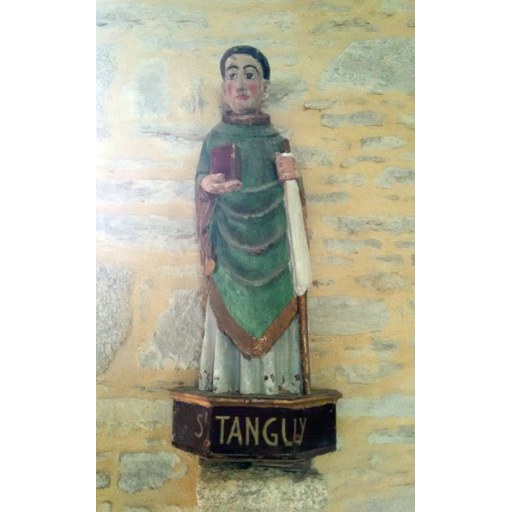
Madamedekeravel
License: CC BY-SA 4.0
Saint Tanguy
Saint- Feast Day
- 19 November
- Gender
- male
- Church
- Catholic
Places
Roles & Family
Biography
Saint Tanguy (Breton: Tangi; also rendered Tanneguy, Tangui, or Tanguy of Brittany) is a saint of early medieval Brittany whose memory is preserved almost entirely through later hagiographic tradition rather than through documents from his own lifetime. He is customarily placed in the sixth century and is associated with the Léon region of western Armorica, in what is now the department of Finistère. Devotion identifies him as the founder and first abbot of the monastery of Saint-Mathieu de Fine-Terre, established at the extreme western point of the Breton peninsula, the site today known as Pointe Saint-Mathieu in the commune of Plougonvelin. No contemporary chronicle or charter confirms the details of his life, and modern historians therefore treat the received story as a foundation legend that grew around an early monastic site and a local cult.
The fullest form of the legend was written down in the early modern period, drawing on older local memory. According to that account, Tanguy was the son of a Breton magnate of Léon—later texts sometimes give the father a name such as Elid—and of a first wife who died while the children were still young. He had a sister, venerated as Saint Haude (Heodez or Houarde). After the father’s remarriage, the stepmother is said to have persecuted Haude and to have slandered her. Tanguy, returning from hunting, believed the false accusation and killed his sister. When the truth became known, he was seized with horror and repentance. The story then describes his abandonment of secular rank: he undertook penance, in some versions leaving Brittany for a time (occasionally with a stay in Ireland, a common motif in Breton saints’ lives), and eventually embraced the monastic life. The portrait is that of a nobleman turned penitent monk; no reliable source records a marriage or children.
Tradition further credits Tanguy with founding a monastery at the western headland of Brittany, on a site already connected in pious memory with the apostle Matthew. That house, the Abbey of Saint-Mathieu de Fine-Terre (Saint-Mahé), later became a notable Benedictine abbey and a landmark for seafarers, but its primitive community would have belonged to the world of early Breton, Celtic-style monasticism rather than to the Benedictine order as later organized. Tanguy is remembered as its first abbot. His sister Haude was honored as a holy innocent or martyr of calumny, and the two cults were often celebrated in tandem, with her feast on 18 November and his on 19 November. The abbey claimed important relics and played a role in the medieval religious landscape of Léon, even though the early centuries of the house remain obscure and were interrupted by Viking raids and later restorations.
Outside western Brittany, Saint Tanguy never acquired a wide cult. He does not appear as a pope or patriarch, and he was not the subject of a formal papal canonization of the kind used in later centuries; his status is that of an early saint whose veneration was established by local usage and liturgical custom. Precise years of birth and death are unknown. Dates such as the year 594 that sometimes appear in older pious lists cannot be verified from independent historical evidence. He is not documented as the patron of a particular profession, illness, or large territory, though he remains a figure of regional Breton hagiography and of the history of the abbey at Pointe Saint-Mathieu. What can be said with caution is that a monastic founder named Tanguy was remembered in Léon, that his legend was shaped to explain both a family tragedy and the origin of a coastal monastery, and that his feast on 19 November continued to be observed in Breton calendars.