Saint Taurinus is a saint of the Catholic Church. Saint Taurinus's feast day is celebrated on 11 August. Saint Taurinus is the patron saint of Évreux;Diocese of Évreux.
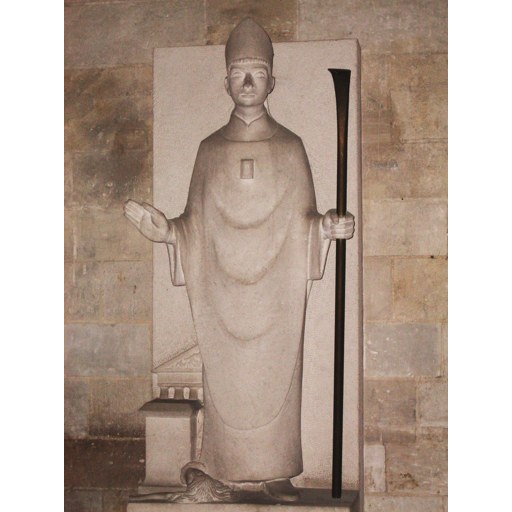
Theoliane
License: Public domain
Saint Taurinus
Saint- Feast Day
- 11 August
- Gender
- male
- Church
- Catholic
Places
Roles & Family
Patronage
Évreux;Diocese of Évreux
Biography
Saint Taurinus (also known as Taurin; Latin: Taurinus) is venerated as the first bishop of Évreux in what is now Normandy, France. Almost nothing about his life can be established from contemporary documents. Later tradition places him in the late fourth or early fifth century, at the period when episcopal sees were being organized in Roman Gaul after the peace of the Church. The Roman Martyrology commemorates him on 11 August as bishop at Évreux. Modern historians generally accept that a bishop of this name headed the church of the Aulerci Eburovices, whose chief town was Mediolanum Aulercorum (later Évreux), but they treat the detailed biography that grew up around him as legendary rather than as a recoverable historical record.
The principal narrative source is a Vita Sancti Taurini composed in the ninth century, long after the events it claims to describe. In that account Taurinus is said to have been born in Rome to a senatorial family, the son of Eusebius and Festa, to have been baptized by Pope Clement I, and to have been sent by the same pope to evangelize Gaul. He is portrayed as destroying a temple of Diana at Évreux, converting the local population, raising a girl named Euphrasia from the dead, and contending with demons and pagan priests. The chronology of the vita is impossible: Clement I died at the end of the first century, whereas the Christianization of this region and the existence of a bishopric at Évreux belong to a much later period. The text is best understood as a typical medieval attempt to give a diocese apostolic or sub-apostolic origins. Some later writers also associated Taurinus with Saint Denis of Paris; that link is likewise unproven.
A more restrained historical picture therefore presents Taurinus simply as the first known bishop of Évreux, active around the end of the fourth century or the beginning of the fifth. Traditional dates of death such as 410 or 412 circulate in later calendars and local histories but rest on the same hagiographical tradition rather than on independent records. He is sometimes called a martyr in popular or older accounts, yet the Martyrology lists him as a bishop, not as a martyr, and there is no early evidence of a martyrdom. His relics were venerated at Évreux. In the tenth century Duke Richard I of Normandy is credited with restoring or founding the Benedictine Abbey of Saint-Taurin over the saint’s tomb; the abbey church of Saint-Taurin in Évreux remained the centre of his cult. Relics were translated at various times and suffered dispersal during the French Revolution, though devotion to him continued in the diocese.
Taurinus is the patron saint of the city and diocese of Évreux. His feast is kept on 11 August. Medieval liturgical books of Normandy and the later Roman Martyrology secured his place in the calendar. Beyond Évreux his cult remained largely regional. Because the surviving life is late and legendary, any reconstruction of his personality, family, or precise career must remain tentative; what can be said with reasonable confidence is that the church of Évreux remembered him from an early date as its founding bishop and that his tomb became a focus of pilgrimage in medieval Normandy.