Saint Terence is a saint of the Eastern Orthodox Church. Saint Terence's feast day is celebrated on 24 September. Saint Terence is the patron saint of Pesaro.
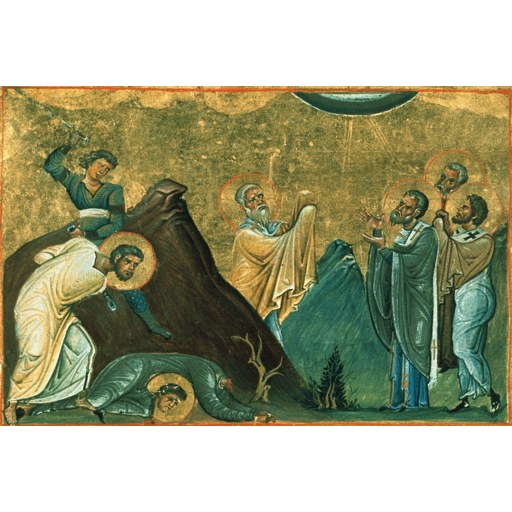
Authors of Menologion of Basil II (circa 985 AC, Constantinople), Byzantine manuscript illuminators[1]: Pantoleon with Georgios, Michael the Younger, Michael of Blachernae, Symeon, Symeon of Blachernae, Menas, and Nestor (Online on Vatican site)
License: Public domain
Saint Terence
Saint- Feast Day
- 24 September
- Gender
- male
- Church
- Eastern Orthodox
Places
Roles & Family
Patronage
Pesaro
Biography
Saint Terence (Italian: San Terenzio di Pesaro) is venerated as the first bishop of Pesaro in the Marche region of central Italy and as that city’s principal patron saint. Almost nothing about him can be established from contemporary or near-contemporary historical sources. The biographical details that circulate in later tradition derive from medieval hagiography, especially a Passio of uncertain date, and from the civic cult that was already firmly rooted in Pesaro by the later Middle Ages. He is not documented in the earliest layers of the martyrologies with an independent, detailed notice, and the first bishops of Pesaro who can be named from reliable records belong to a much later period than the age in which the legend places him.
According to the traditional legend, Terence was of noble birth and came from Pannonia, the Roman province that covered parts of the middle Danube basin (roughly corresponding to areas of present-day Hungary and neighboring lands). He is said to have traveled to Italy, perhaps as a missionary, and to have preached Christianity along the Adriatic coast in the territory of Pesaro. Local tradition identifies him as the first bishop of that see. None of these particulars—origin, journey, or episcopal rank—can be confirmed independently. Early Italian episcopal lists and the surviving documentary record do not corroborate a third-century bishop of Pesaro by this name, and modern scholarship generally treats the Pannonian origin story as a conventional hagiographic motif rather than as verified biography.
The same legendary cycle presents Terence as a martyr. During a persecution of Christians, commonly associated in the texts with the reign of the emperor Decius in the mid-third century, he is said to have been arrested, subjected to torture, and beheaded. Some versions mention companions who suffered with him. The association with the Decian persecution supplies the approximate date often repeated in later calendars and popular accounts, but it rests on the Passio rather than on independent evidence. Historically, the Decian edict of 250 is well attested as an empire-wide demand for sacrifice, yet there is no contemporary witness that ties a bishop of Pesaro named Terence to those events. The martyrdom narrative should therefore be read as the pious tradition that shaped his cult, not as a recoverable historical transcript.
The cult of Saint Terence became central to the religious identity of Pesaro. His relics have long been preserved in the city’s cathedral, the Duomo of Santa Maria Assunta, where they were the object of public veneration and of later translations, including a notable fifteenth-century translation. His liturgical feast is kept on 24 September. In art he is typically shown as a bishop, sometimes with the palm of martyrdom. Devotion to him remained strong in the Marche, and he continues to be invoked as patron of Pesaro. The continuity of the feast, the presence of the relics, and his role as civic patron are well attested from the medieval period onward, even though they do not by themselves prove the third-century biography.
Because the historical Terence, if he existed as a distinct individual, left no writings and is not securely anchored in early documentary sources, he belongs to the large group of Italian civic patron saints whose lives were shaped by medieval urban piety. Historians therefore distinguish carefully between the well-documented cult—relics, feast day, and patronage of Pesaro—and the largely unrecoverable biography. The legend remains important for the history of devotion in the Marche, but it cannot be used as a chronicle of a verifiable third-century career.