Saint Thorlak is a saint of the Catholic Church (1133 - 1193). Saint Thorlak's feast day is celebrated on 23 December (principal feast); 20 July (translation of relics). Saint Thorlak is the patron saint of Iceland.
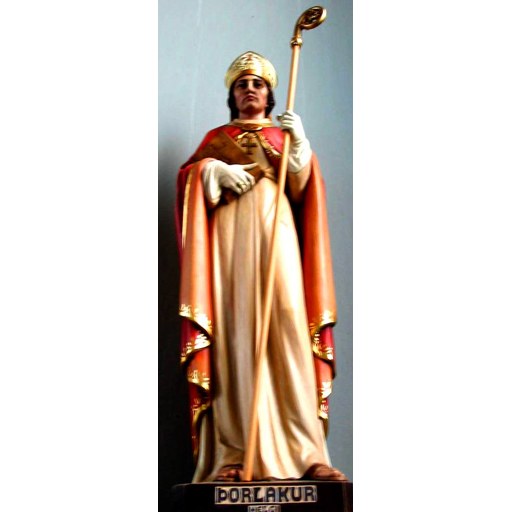
Користувач:Roman_Z / User:Roman_Z
License: CC BY-SA 2.5
Saint Thorlak
Saint- Life Span
- 1133 - 1193 (age 60)
- Feast Day
- 23 December (principal feast); 20 July (translation of relics)
- Gender
- male
- Church
- Catholic
Places
Roles & Family
Religious Information
Patronage
Iceland
Canonization
Biography
Saint Thorlak (Icelandic: Þorlákur Þórhallsson) was born in 1133 at Hlíðarendi in Fljótshlíð, in southern Iceland, during the Icelandic Commonwealth. Medieval accounts, above all Þorláks saga helga, present him as a youth of notable piety from a family of local standing. He was ordained deacon while still in his teens and priest at about eighteen. In the mid-twelfth century he left Iceland for higher study, spending several years in Paris and then at Lincoln in England, where he was trained in theology and canon law and absorbed the reforming ideals then current in the Western Church. He returned home in the early 1160s and lived as a priest in the south, refusing advantageous marriages urged by his kin in order to remain celibate.
In 1168 he became the first abbot of the Augustinian house of Canons Regular at Þykkvabær in Álftaver, the earliest such community in Iceland. As abbot he was remembered for austerity, regular observance, and pastoral care. After the death of Bishop Klængur Þorsteinsson he was chosen bishop of Skálholt, the principal see of southern Iceland. Because Iceland then belonged to the ecclesiastical province of Nidaros, he travelled to Norway and was consecrated in 1178 by Archbishop Eysteinn Erlendsson.
From 1178 until his death Thorlak tried to apply Gregorian reform in a society whose chieftains often treated churches as private property. He insisted on clerical celibacy, ecclesiastical control of church estates, and the use of canon law in marriage and morals. These demands brought him into open conflict with powerful laymen, most famously Jón Loftsson of Oddi, who would neither surrender a church nor end an irregular union with Thorlak’s sister Ragnheiður. Thorlak’s success against entrenched custom was limited, but he gained a lasting reputation for learning, personal holiness, and firmness. He died at his see of Skálholt on 23 December 1193 and was buried there.
Miracles were soon reported at his tomb. In 1198 the Althing authorized his veneration and the translation of his relics, carried out at Skálholt on 20 July 1198. His nephew Páll Jónsson, who succeeded him as bishop, promoted the cult, and both Latin and vernacular lives circulated in Iceland. Thorlak remained the island’s chief native saint through the later Middle Ages. The Lutheran Reformation dismantled his shrine, yet popular observance of Þorláksmessa on 23 December survived. On 14 January 1984 Pope John Paul II confirmed him as patron saint of Iceland. His principal feast is 23 December; the translation is kept on 20 July.