Saint Thumette is a saint of the Catholic Church.
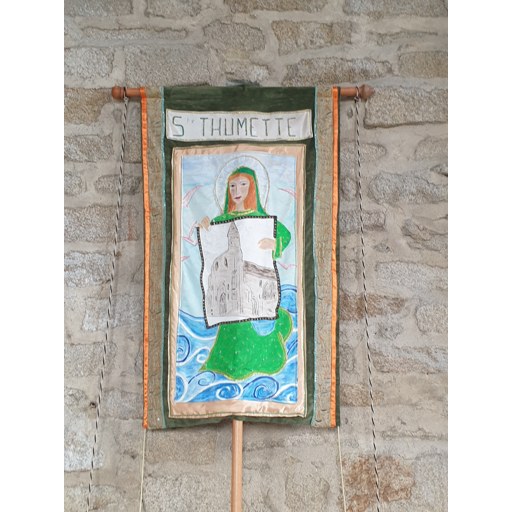
Chris06
License: CC BY-SA 4.0
Saint Thumette
Saint- Gender
- female
- Church
- Catholic
Roles & Family
Biography
Saint Thumette, known in French as Sainte Thumette, is an obscure female saint of Brittany whose historical existence is poorly documented and whose cult is essentially local. She belongs to the large company of early medieval Breton holy figures whose memory was preserved through chapel dedications, oral tradition, and later antiquarian or hagiographical lists rather than through contemporary written sources. No vita from her own age, and no securely dated notice in the major early martyrologies, has been identified. Consequently, a year of birth, a year of death, a birthplace, and a place of burial cannot be established from reliable historical evidence. What can be said with some confidence is that she was venerated as a woman saint in the Léon country of northern Finistère, and that a chapel under her name at Landéda, near the Aber Wrac’h, attests a lasting popular devotion.
Local tradition in that part of Brittany has often identified Thumette as one of the companions of Saint Ursula, the legendary British princess said to have been martyred at Cologne with a great following of virgins. In this strand of folklore, some of Ursula’s companions escaped the massacre, reached the Armorican coast, and lived thereafter as hermits. Thumette is said in such accounts to have come ashore in the country of Léon and to have spent her life in prayer and solitude. That identification, however, is legendary rather than historical. The Ursula cycle itself is largely a medieval literary construction, and the attachment of local Breton names to it is a familiar hagiographical pattern by which coastal communities explained ancient dedications. It should not be treated as a verified biography.
Other, equally uncertain reconstructions have sometimes placed Thumette in the circle of sixth-century monastic founders of western Brittany, or have made her the sister of a local hermit such as Saint Guévroc (Kirec) of Plounéour-Trez, a figure associated with the mission of Saint Paul Aurelian. These kinship claims appear in popular or genealogical accounts of “holy families” of Brittany; they are not confirmed by early, independent vitae and remain unproven. No contemporary or near-contemporary Life of Thumette is known to survive, and she does not occupy a prominent place in the principal medieval legendaries of the region. Whether she was a hermit, a member of a small female community, or a figure whose name was later attached to an older cult site cannot be determined from the evidence that remains.
Her recognition was of the kind usual for early Breton saints: popular and episcopal cult rather than a Roman process of canonization or beatification. There is no record of a papal canonization, and no securely established feast in the universal calendars. Modern historical scholarship therefore treats her as a figure of regional piety whose story illustrates how communities of western Brittany appropriated and localized broader Christian legends. Beyond the Landéda dedication and scattered mentions among lists of Breton saints, little can be stated with confidence. The caution required by the sources is itself part of her historical profile: she is known because a place remembered her, not because a biographer of her own century described her life.