Saint Turiau is a saint of the Catholic Church (d. 749). Saint Turiau's feast day is celebrated on 13 July. Saint Turiau is the patron saint of Saint-Thuriau.
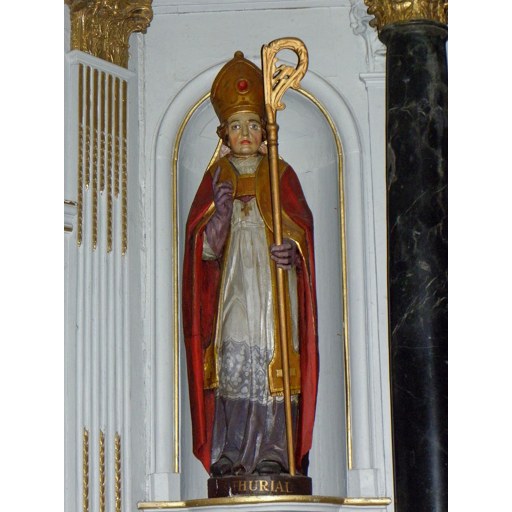
GO69
License: CC BY-SA 4.0
Saint Turiau
Saint- Life Span
- d. 749
- Feast Day
- 13 July
- Gender
- male
- Church
- Catholic
Places
Roles & Family
Patronage
Saint-Thuriau
Biography
Saint Turiau, known in Latin as Turiavus or Turianus and in Breton as Turiav (also spelled Turiaf, Turiave, or Thurian), was a Breton saint commemorated as a bishop of Dol. He belongs to the early medieval Breton sanctoral and is usually placed in the seventh and eighth centuries. Almost everything recorded about him comes from later liturgical tradition and from hagiographical compilations of the Middle Ages and the early modern period, not from charters or chronicles written in his own lifetime. For that reason his biography must be reconstructed with caution. He is nonetheless a well-established figure in Breton devotion, and the see of Dol counted him among its early bishops. Standard notices date his death to about 749, a year that rests on later tradition rather than on a contemporary obituary.
Tradition, as reported by Breton hagiographers such as Albert Le Grand in the seventeenth century, holds that Turiau was born at Lizou, a locality in the parish of Langoëlan in the Vannetais (present-day Morbihan in Brittany). He is described as coming from a family of standing and as showing religious seriousness from youth. He entered the clerical life, was ordained priest, and gained a reputation for austerity, prayer, and charity. Later legend sometimes makes him a personal disciple of Saint Samson of Dol, the sixth-century founder of the monastery-bishopric. That association is chronologically implausible if Samson died in the mid-sixth century and Turiau in the mid-eighth, and it is better read as a way of linking Turiau to the prestige of Dol’s founder than as a literal master-disciple relationship. More restrained accounts simply place him in the succession of Dol after the generation of Samson and Magloire, though the early episcopal list of Dol itself is only partly historical.
The medieval Life presents Turiau as elected bishop of Dol and as a pastor distinguished by care for the poor and by miracles of healing. Such episodes—cures of the sick, deliverance from affliction, and other wonders—are typical of Breton vitae and cannot be confirmed as discrete historical events. What can be said is that Dol was a monastic bishopric of importance in northern Brittany, that a saint of this name was identified with that see, and that his cult took root in the region. Historians generally accept that a holy bishop or monastic cleric named Turiau was venerated in Brittany in the early Middle Ages and that later tradition fixed him at Dol. The see followed the Insular monastic-episcopal pattern associated with Samson, so Turiau is remembered as a celibate prelate rather than as a married chieftain-bishop.
He is held to have died at Dol about the middle of the eighth century and to have been buried there, presumably at the episcopal church that later became the cathedral of Saint-Samson. His feast day is 13 July in Breton and wider Catholic calendars. Like most saints of the first Christian centuries in the West, he was not canonized by a formal papal process; his sanctity rests on ancient public cult. Parishes and chapels under his invocation, above all the commune of Saint-Thuriau in Morbihan, kept his name in local devotion. Relics associated with him were preserved at Dol as part of the cathedral’s treasury of saints. In the absence of contemporary documentation, the prudent conclusion is that Turiau was a genuine object of Breton veneration and a bishop (or monastic founder later styled bishop) connected with Dol, whose personal history has been overlaid by the conventional themes of medieval hagiography.