Saint Valentine is a saint of the Pre-Schism (Universal) Church (d. 269). Saint Valentine's feast day is celebrated on February 14. Saint Valentine is the patron saint of lovers;engaged couples;happy marriages;beekeepers;epilepsy;plague;fainting;travellers;young people;Terni.
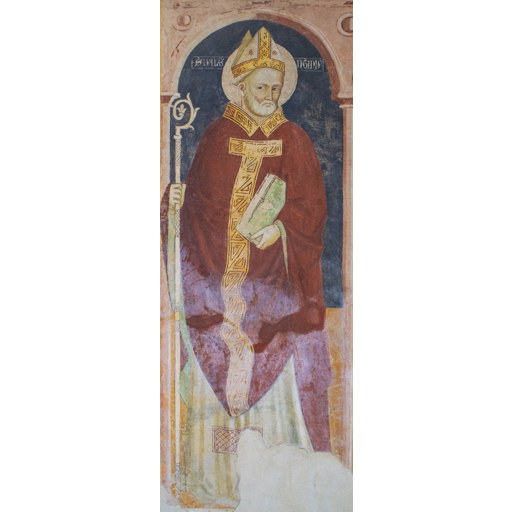
Giosuè Tacconi
License: CC BY-SA 4.0
Saint Valentine
Saint- Life Span
- d. 269
- Feast Day
- February 14
- Gender
- male
- Church
- Pre-Schism (Universal)
Places
Roles & Family
Patronage
lovers;engaged couples;happy marriages;beekeepers;epilepsy;plague;fainting;travellers;young people;Terni
Biography
Saint Valentine, whose Latin name Valentinus derives from valens, meaning strong or powerful, is among the most widely commemorated yet least historically documented saints of the early Church. Contemporary third-century sources do not mention him, and the earliest Roman list of martyrs, the Chronography of 354, omits his name. The Roman Martyrology records a priest named Valentine who suffered martyrdom at Rome and was buried on the Via Flaminia, as well as a bishop of Interamna (present-day Terni) of the same name who was likewise said to have been put to death in Rome. Pope Gelasius I, writing in 496, placed Valentine among those whose names were justly honoured but whose deeds were known only to God, an admission that reliable biographical information had already been lost. Later medieval passiones supplied the missing narrative, but modern hagiographers treat those texts as legendary rather than historical.
According to the most familiar legend, Valentine was a priest in Rome during the reign of the emperor Claudius II Gothicus. The emperor, so the story goes, had forbidden young men to marry, believing that unmarried soldiers fought more fiercely. Valentine defied the edict by secretly celebrating Christian marriages. Arrested for this and for his refusal to renounce the faith, he was imprisoned, where he is said to have healed the blindness of his jailer's daughter. On the eve of his execution he sent her a note signed "from your Valentine." He was then beaten and beheaded on 14 February, traditionally assigned to the year 269, and buried along the Flaminian Way north of the city. A parallel tradition identifies him as bishop of Terni who was summoned to Rome, converted members of the imperial household, and suffered the same fate, after which his relics were returned to Terni. Historians regard both narratives as later elaborations that cannot be verified from third-century evidence.
A basilica dedicated to Saint Valentine was erected on the Via Flaminia in the fourth century, confirming that a cult of a martyr of that name existed at Rome by late antiquity. Relics attributed to him have been claimed by numerous churches, including the Basilica of Saint Valentine in Terni, Santa Maria in Cosmedin in Rome, the Whitefriar Street Carmelite Church in Dublin, and churches in Prague, Madrid, and elsewhere. He is venerated in the Roman Catholic Church, where his optional memorial was removed from the General Roman Calendar in 1969 because of the legendary character of the sources, though he remains listed in the Roman Martyrology and may still be honoured locally on 14 February. The Anglican Communion and Lutheran churches likewise keep his feast, and the Eastern Orthodox Church commemorates him, sometimes on 6 July as well as on 14 February.
The association of Saint Valentine with romantic love is a medieval and early modern development rather than an ancient one. In the late fourteenth century Geoffrey Chaucer, in The Parliament of Fowls, linked the saint's feast with the pairing of birds in spring, and by the fifteenth century the custom of choosing a valentine and exchanging love tokens on 14 February had appeared in England and France. The commercial greeting-card industry of the nineteenth century transformed the day into a popular celebration of romantic affection. Independently of that later overlay, Christian tradition has long invoked Valentine as patron of lovers, engaged couples, and happy marriages, as well as of beekeepers, travellers, young people, and those afflicted with epilepsy, plague, and fainting. His cult remains especially lively in Terni, which regards him as its bishop and principal patron. Although almost nothing of his earthly life can be established with historical certainty, the figure of Saint Valentine has shaped both liturgical commemoration and popular culture for more than fifteen centuries.