Saint Varus is a saint of the Catholic Church (d. 307). Saint Varus's feast day is celebrated on 19 October. Saint Varus is the patron saint of those who died without baptism.
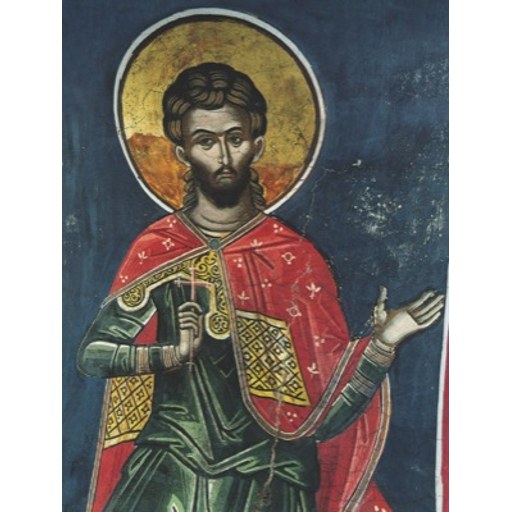
Zoris Fuka
License: Public domain
Saint Varus
Saint- Life Span
- d. 307
- Feast Day
- 19 October
- Gender
- male
- Church
- Catholic
Places
Roles & Family
Patronage
those who died without baptism
Biography
Saint Varus was an early Christian martyr of the Roman persecutions in Egypt, remembered in both Eastern and Western calendars on 19 October. Almost everything that can be said about him comes from later hagiography rather than from contemporary historical writing. He does not appear by name in the surviving works of Eusebius of Caesarea or in other fourth-century documentary sources. The principal account is a Greek Passion, which presents him as a soldier serving with the Roman army in Egypt in the opening years of the fourth century, in the time of the emperor Maximian and of the persecutions that continued in the East under Maximinus Daia. According to this tradition he was already a Christian, though he had not made his faith public, and he used his position to visit Christians held in prison, bringing them food and tending their wounds.
The narrative turns on a group of seven Christian ascetics or teachers who had been seized in the Egyptian desert and imprisoned. Varus attended them regularly. When one of the seven died under torture, Varus openly confessed that he too was a Christian and took the dead man's place among the condemned. Brought before a magistrate, he refused to offer sacrifice to the gods of the empire. The Passion describes a harsh martyrdom: he was hung from a tree or wooden frame and his body was lacerated with iron claws or hooks until he died. The conventional date assigned to his death is about 307, during the Egyptian phase of the last great persecution. The remaining companions were put to death afterward. Because the story is known only from later liturgical and hagiographical texts, the precise place of execution within Egypt is not independently verified.
A second part of the legend, which became important for his cult, concerns a Christian widow named Cleopatra, described as coming from a Palestinian village called Edra. Her husband had served as a soldier and had died in Egypt. Cleopatra recovered Varus's body, which according to the story had been cast out after the execution, and brought the relics to Palestine. There she buried them and in time built a church in the martyr's honor. The account continues that her only son, often named John, died, and that in her grief she complained to the saint; Varus then appeared to her in a vision together with the boy, showing that the child had been received in glory. Whatever the historical value of this episode, it was transmitted in the synaxaria of the Christian East together with the names of the six monk-martyrs and of Blessed Cleopatra.
Saint Varus was venerated as a martyr from an early period in the East and was later entered in the Roman Martyrology on the same October date. He held no episcopal or papal office and is not recorded as a member of a religious order; the sources present him as a soldier. No reliable evidence preserves his year of birth, his native city, or any marriage or children. In later Orthodox devotion, especially in the Russian tradition, the faithful have addressed prayers to him on behalf of those who died without baptism or outside the visible communion of the Church, an association that grew from the Cleopatra story and from subsequent spiritual practice rather than from fourth-century testimony. The burial place named in the earliest layer of the legend is the shrine established by Cleopatra at Edra in Palestine.