Saint Wenceslaus I, Duke of Bohemia is a saint of the Catholic Church (907 - 935). Saint Wenceslaus I, Duke of Bohemia's feast day is celebrated on 28 September. Saint Wenceslaus I, Duke of Bohemia is the patron saint of Bohemia;Czech Republic;Prague;Moravia;Czech people.
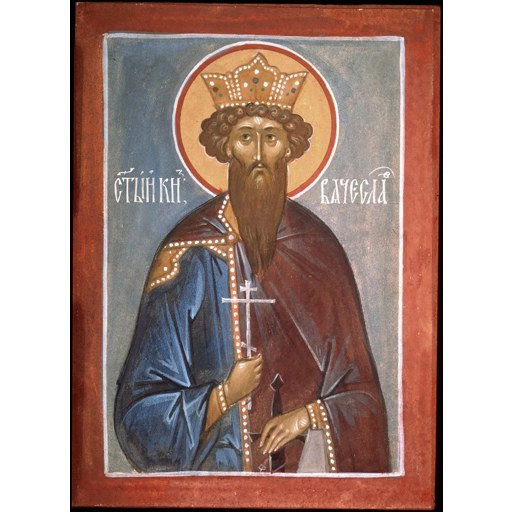
Medival bohemian icon creator.
License: Public domain
Saint Wenceslaus I, Duke of Bohemia
Saint- Life Span
- 907 - 935 (age 28)
- Feast Day
- 28 September
- Gender
- male
- Church
- Catholic
Places


Relics & Where to Venerate
Location unknown
The bodily remains of Saint Wenceslaus I, Duke of Bohemia are a first-class relic. Venerated at St. Vitus Cathedral.
Roles & Family
Patronage
Bohemia;Czech Republic;Prague;Moravia;Czech people
Biography
Saint Wenceslaus I, known in Czech as Václav, was Duke of Bohemia in the early tenth century and is venerated as a martyr and as the principal patron saint of the Czech lands. He was born about 907 into the Přemyslid dynasty, the son of Duke Vratislaus I and Drahomíra, a princess of the Hevelli (Stodorane) of the middle Elbe. Christianity had only recently taken hold among the Bohemian elite, through the mission associated with Saints Cyril and Methodius and through contacts with Bavaria and Saxony. After Vratislaus died in 921, the still-youthful Wenceslaus was raised in the Christian faith by his paternal grandmother, Saint Ludmila, who had been baptized with her husband Bořivoj I. Ludmila’s influence, and the question of who would control the young duke, produced a bitter struggle with Drahomíra. Ludmila was murdered at Tetín in September 921, an act that later hagiography attributed to Drahomíra’s instigation. Wenceslaus then assumed personal rule. He is reported to have sent his mother into exile for a time and afterwards to have been reconciled with her.
As duke, Wenceslaus promoted the Latin Christian church in Bohemia. He is credited with founding or completing a rotunda dedicated to Saint Vitus at Prague Castle, the church that later grew into the cathedral of that name and that would house his tomb. He favored clergy, encouraged church building, and acquired a reputation—heavily elaborated in legends written within a few generations of his death—for personal piety, justice, and charity toward the poor, prisoners, and the sick. Politically he accepted a tributary or subordinate relationship with the Saxon king Henry I (Henry the Fowler), aligning Bohemia with the East Frankish realm rather than pursuing a fully independent or anti-Saxon course. That orientation, together with his ecclesiastical preferences, alienated a party of Bohemian nobles. His younger brother Boleslaus (Boleslav, later called “the Cruel”) became the leader or at least the beneficiary of that opposition. Reliable sources do not record a wife or children; the ducal succession passed to Boleslaus.
The early Latin and Slavic legends agree that Boleslaus invited Wenceslaus to the stronghold of Stará Boleslav, east of Prague, in connection with a feast of the martyr-physicians Saints Cosmas and Damian. There Wenceslaus was attacked and killed by Boleslaus and his retainers, according to tradition on 28 September, either at the church door or on the way to Matins. Much modern reference literature dates the murder to 935, though 929 also has medieval support and scholarly defenders; the discrepancy is bound up with the reconstruction of Henry I’s campaigns and of Bohemian-Saxon relations. The killing was understood by Wenceslaus’s supporters as martyrdom. Boleslaus succeeded as duke. Relatively soon the body was translated from Stará Boleslav to the church of Saint Vitus in Prague, an act that both acknowledged the dead brother’s sanctity and served the new ruler’s need for legitimacy. A tomb cult arose at Prague, and Wenceslaus’s fame spread into Saxony, Bavaria, and the wider Ottonian world. He was venerated as a saint by popular and princely acclaim in an age before the later formal papal canonization process; no specific pope is securely recorded as having canonized him.
In later centuries Saint Wenceslaus became the emblem of Bohemian Christian rulership and of Czech political identity. Medieval kings of Bohemia placed their coronation crown under his patronage, and it is still called the Crown of Saint Wenceslas. His principal feast, 28 September, is a public holiday in the Czech Republic. He is invoked as patron of Bohemia, of the Czech Republic, of Moravia, of the city of Prague, and of the Czech people. Later folklore and art depicted him as a warrior-saint and generous almsgiver. The well-known English Christmas carol “Good King Wenceslas,” written in the nineteenth century, anachronistically styles the duke a king and sets a legend of his charity on the feast of Saint Stephen. Historians distinguish a plausible tenth-century core—a Christian Přemyslid duke murdered in a dynastic feud and rapidly venerated—from later miracle stories and national myth. His relics remain associated with Saint Vitus Cathedral at Prague Castle, and his cult continues to occupy a central place in Czech religious and civic memory.