Sancha of Majorca is a blessed of the Catholic Church (d. 1345).
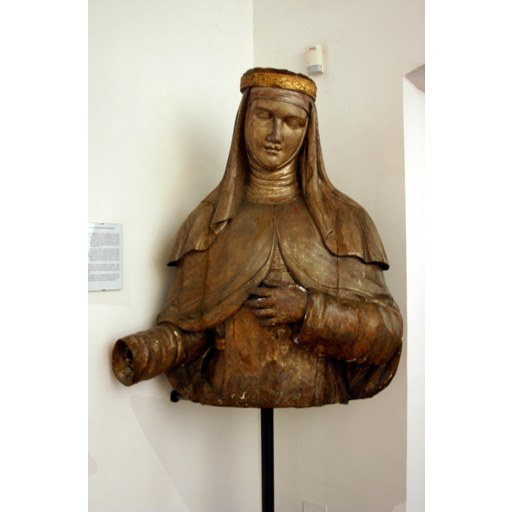
José Luiz
License: CC BY-SA 4.0
Sancha of Majorca
Blessed- Life Span
- d. 1345
- Gender
- female
- Church
- Catholic
Places
Relics & Where to Venerate
Location unknown
The bodily remains of Sancha of Majorca are a first-class relic. Venerated at Santa Chiara.
Housed at Basilica di Santa Chiara · Italy
Initially was buried at Santa Maria della Croce, but later her remains where translated to Santa Chiara Basilica
Roles & Family
Religious Information
Biography
Sancha of Majorca, also called Sancia of Mallorca, was a fourteenth-century princess of the Catalan house of Barcelona who became queen consort of Naples. She was born in the later thirteenth century, conventionally around 1285, as a daughter of King James II of Majorca and Queen Esclaramunda of Foix. The Kingdom of Majorca, a cadet realm of the Crown of Aragon, comprised the Balearic Islands together with mainland lordships in Roussillon and Cerdanya. In 1304 she was married to Robert of Anjou, Duke of Calabria, heir to the throne of Naples. Robert had previously been married to Yolanda of Aragon, who died in 1302, leaving a son, Charles of Calabria. Sancha’s marriage produced no children. When Charles II of Naples died in 1309, Robert succeeded as king and Sancha became queen.
During her long tenure as queen she was closely associated with the religious and cultural policy of the Angevin court. Together with Robert she founded the monumental church and convent of Santa Chiara in Naples, begun in the 1310s, which served as a royal mausoleum and a house of Poor Clares. She also founded the convent of Santa Croce (Santa Maria della Croce) in the city. Her patronage extended to hospitals and other pious works. Contemporaries remarked on her personal austerity and her preference for Franciscan spirituality at a court otherwise known for legal learning and Italian literary culture under Robert the Wise.
Sancha’s most distinctive political-religious role was as a protector of the Spiritual Franciscans, who defended a strict interpretation of evangelical poverty against the settlements favored by the papacy. In the decades when Pope John XXII condemned aspects of the Spiritual program and moved against their leaders, the Neapolitan court offered a relatively sympathetic environment. Sancha used her influence to shelter rigorist friars and to sustain networks connected with figures such as Angelo Clareno. This stance placed her, and at times her husband, at odds with Avignon, but it also made her an important lay ally of a contested current within the Franciscan order.
Robert died in January 1343. His granddaughter Joanna I inherited the crown. Robert’s will assigned Sancha a place among the queen’s advisers, and she remained for a short period a figure at court during the unstable opening of Joanna’s reign. In 1344 Sancha left secular life, received the habit of the Order of Saint Clare, and entered the convent of Santa Croce that she had established. She died there on 28 July 1345 and was buried in the convent.
Sancha was not canonized or beatified by the Catholic Church, and she has no universal feast day or official patronages. Her historical importance lies in her position as queen of Naples, as a major founder of Clarissan houses in that kingdom, and as a royal woman whose piety took a publicly Franciscan and, in the controversies of her age, distinctly Spiritual coloring. Franciscan and Neapolitan tradition remembered her as a devout queen and religious foundress of the first half of the fourteenth century.