Sebaldus is a saint of the Catholic Church. Sebaldus's feast day is celebrated on 19 August. Sebaldus is the patron saint of Nuremberg;against cold weather;against frost.
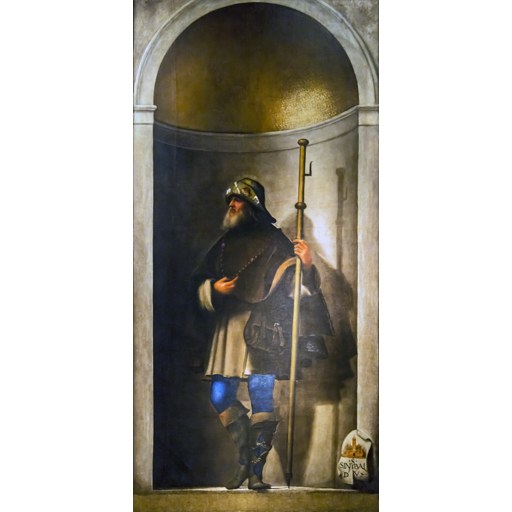
Didier Descouens
License: Public domain
Sebaldus
Saint- Feast Day
- 19 August
- Gender
- male
- Church
- Catholic
Places
Roles & Family
Patronage
Nuremberg;against cold weather;against frost
Canonization
Biography
Saint Sebaldus, also known as Sebald or Sinibald, is a Christian saint venerated especially in Franconia as the patron of Nuremberg. Almost nothing about his life can be established from contemporary records. The earliest documentary references to his cult appear only in the eleventh century, long after the period in which he is usually placed, and the surviving lives of the saint were composed in the later Middle Ages. Historians therefore treat the biographical details as legendary rather than as securely attested fact, while acknowledging that a local holy man of that name was almost certainly buried at the site that later became Nuremberg’s principal parish church. Conventional dates such as a death around 770 rest on later tradition, not on contemporary evidence, and competing legends even disagree on the century in which he lived.
Medieval tradition offers more than one account of his origin. One widely circulated legend, developed in later vitae, presents him as the son of a Danish king who was sent to Paris for his education, contracted a marriage with a Frankish princess, and then, by mutual consent, lived with her in continence before departing on pilgrimage to Rome. From Rome he is said to have received a papal commission to preach in the German lands and eventually to have settled as a hermit in the imperial forest (Reichswald) near the later city of Nuremberg. Another strand of tradition associates him with the eighth-century Anglo-Saxon mission in Bavaria and Franconia, making him a companion of Saints Willibald, Winibald, and Walburga and thus a figure of the circle connected with Saint Boniface. These stories cannot be reconciled in detail and likely reflect the desire of a growing civic cult to supply the hermit with a distinguished pedigree. No reliable historical source confirms his birthplace, family, or nationality.
According to the same legends, Sebaldus lived in a forest hermitage, preaching to the surrounding population and performing miracles that later became central to his iconography. The best-known miracle recounts that, when he and a poor man who had given him hospitality lacked fuel on a bitterly cold night, the saint blessed icicles hanging from the eaves and they burned like firewood; this episode underlies his later invocation against cold and frost. Other stories describe him producing a spring of water, converting a scoffer, and remaining unharmed when hostile people attempted to burn him. He is consistently portrayed as a priest and hermit rather than as a member of a formal religious order. No historically reliable source records a wife or children; the chaste-marriage episode belongs to late hagiography rather than to documented biography.
Sebaldus is said to have died in his hermitage and to have been buried at the place where the Church of Saint Sebald (Sebalduskirche) later rose in Nuremberg. That church, rebuilt in the thirteenth and fourteenth centuries as a major Gothic hall church, became the centre of a civic cult that grew with Nuremberg’s commercial and political importance. Papal interest in the shrine is attested by the later twelfth century. The cult received formal canonization from Pope Martin V on 26 March 1425. In the early sixteenth century the bronze shrine of Saint Sebald, executed by Peter Vischer the Elder and his sons and completed in 1519, was installed over the tomb and remains one of the masterpieces of German Renaissance sculpture.
The Roman Martyrology and the local calendar keep his feast on 19 August. He is the principal patron of Nuremberg and is invoked against cold weather and frost. His relics and shrine continued to draw pilgrims through the later Middle Ages, and he remains a defining figure in the religious and civic identity of the city, even though the precise century of his life and the facts of his birth cannot be verified from contemporary historical evidence.