Secundus of Abula is a saint of the Pre-Schism (Universal) Church. Secundus of Abula's feast day is celebrated on 2 May (Ávila); 15 May (with the Seven Apostolic Men). Secundus of Abula is the patron saint of Ávila.
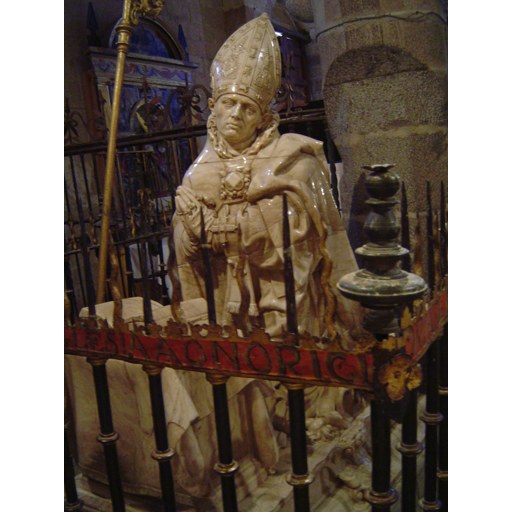
Pizicato
License: Public domain
Secundus of Abula
Saint- Feast Day
- 2 May (Ávila); 15 May (with the Seven Apostolic Men)
- Gender
- male
- Church
- Pre-Schism (Universal)
Places
Roles & Family
Patronage
Ávila
Biography
Secundus of Abula, known in Spanish as San Segundo, is a Christian saint of the apostolic age whose life is known almost entirely from later hagiographical tradition rather than from contemporary historical records. He is numbered among the Seven Apostolic Men (los siete varones apostólicos)—Torquatus, Ctesiphon, Secundus, Indaletius, Caecilius, Hesychius, and Euphrasius—who, according to medieval Spanish legend, were ordained in Rome by the Apostles Peter and Paul and sent to evangelize the Iberian Peninsula in the first century. Within that tradition Secundus is identified as the first bishop of Abula. No verified year of birth or death survives, nor any reliable account of his family, place of origin, or personal circumstances.
The legend of the Seven Apostolic Men was elaborated in the early medieval period and became an important strand of Spanish ecclesiastical identity, linking the origins of several sees in Hispania to the generation of the apostles. The usual narrative holds that the seven were consecrated bishops at Rome and dispatched into Spain, where they founded Christian communities. Abula is named by the ancient geographer Ptolemy in the territory of the Bastetani. Later Spanish devotion, especially at Ávila, equated Abula with that city and honoured Secundus as its protobishop. Modern scholarship has often preferred to identify Abula with Abla in the province of Almería rather than with Ávila, so even the geography of the tradition is disputed. There is no first-century evidence that independently confirms Secundus’s existence, episcopate, or manner of death. Some later accounts describe the seven as martyrs; others present them as missionary bishops and confessors. Reliable sources do not preserve a birthplace, a death date, or a documented spouse or children.
Devotion to Secundus at Ávila took a concrete form in the early sixteenth century. In 1519 remains identified as those of San Segundo were discovered at a hermitage outside the city walls, near the river Adaja. The find was treated as a major event in local religious life: the relics were examined, the cult was encouraged by ecclesiastical authorities, and a rebuilt shrine—the Ermita de San Segundo—became the principal focus of veneration. The Romanesque hermitage by the river below the medieval walls remains a notable monument of Ávila. Relics and images of the saint were also associated with the cathedral and with civic ceremonies, and later translations and public expositions of the relics, including in the 1590s, reinforced his standing as a civic and diocesan patron. The cult belongs to the pre-congregation era: Secundus was not the subject of a modern papal canonization process, but of an ancient and then late-medieval and early-modern local cult that the Church recognized.
In the liturgical calendar Secundus is commemorated with the other Apostolic Men on 15 May in the Roman Martyrology. In Ávila the principal local feast of San Segundo is observed on 2 May. He is venerated as patron of the city of Ávila. Historians treat him as a figure of legendary hagiography whose traditional role as first bishop of Abula has had lasting importance for Spanish Christian memory, even while the biographical facts of a first-century bishop of that name cannot be verified from contemporary records. What can be documented with confidence is the shape of his cult: a first-century missionary bishop in the Spanish legendary cycle, a relic discovery at Ávila in 1519, a riverside hermitage as the centre of devotion, and a double liturgical commemoration in May.