Seiriol is a saint of the Catholic Church. Seiriol's feast day is celebrated on 1 February. Seiriol is the patron saint of Penmon.
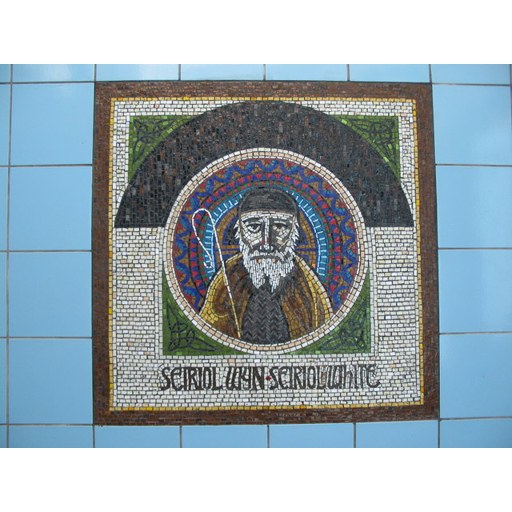
Phil Williams
License: CC BY-SA 2.0
Seiriol
Saint- Feast Day
- 1 February
- Gender
- male
- Church
- Catholic
Places
Roles & Family
Patronage
Penmon
Biography
Saint Seiriol was a Welsh holy man of the sixth century, remembered as the founder of the monastic community at Penmon on the eastern coast of the Isle of Anglesey (Ynys Môn) in north Wales. Medieval Welsh genealogical tracts, notably the Bonedd y Saint, present him as a son of Owain Danwyn (Owain Ddantgwyn), a ruler associated with the kingdom of Rhos in what is now north-east Wales, and as a brother of Einion Frenin, king of Llŷn, and of Cynlas (Cynlas Goch) of Rhos. These pedigrees also connect him with the wider dynasty of Gwynedd, including a relationship to the powerful king Maelgwn Gwynedd. No contemporary written life of Seiriol survives, and neither a precise year of birth nor of death can be established from reliable sources. His activity is placed by tradition in the early to mid sixth century, during the period often described as the Age of the Saints in western Britain.
According to later tradition, Seiriol established a hermitage and then a small monastery at Penmon, a site that still preserves a holy well known as St Seiriol's Well, a medieval church dedicated to him, and substantial remains of a twelfth-century Augustinian priory that developed on the older foundation. The well and an adjacent stone cell are popularly associated with the saint's own eremitical life. Penmon's position on the shore facing the small island later called Ynys Seiriol (Puffin Island, also known in medieval sources as Ynys Lannog or Priestholm) made it a natural centre for a coastal monastic settlement. The community that claimed Seiriol as founder remained of local importance through the early Middle Ages. By the twelfth century it had been reorganised as an Augustinian house under the patronage of the princes of Gwynedd.
A well-known legend links Seiriol with his contemporary Saint Cybi, who is said to have lived at Caer Gybi (Holyhead) at the western extremity of Anglesey. The two saints are described as meeting weekly at the wells of Clorach, near Llandyfrydog in the centre of the island. Because Seiriol walked westward from Penmon in the morning, with the sun at his back, and returned eastward in the afternoon, he remained pale and was called Seiriol Wyn (Seiriol the Fair, or the White). Cybi, walking eastward into the morning sun, became tanned and was called Cybi Felyn (Cybi the Tawny). The story, whatever its historical value, reflects the medieval memory of two complementary monastic centres at opposite ends of Anglesey and has remained a staple of local hagiographical tradition.
In later life Seiriol is said to have withdrawn from Penmon to the offshore island of Ynys Lannog, which thereafter bore his name as Ynys Seiriol. There he lived as a hermit and, according to tradition, died and was buried. Traces of an early monastic site on Puffin Island, including a later medieval tower, have been associated with this community. Seiriol's cult remained essentially local. His feast is observed on 1 February. He was never the subject of a formal papal canonisation of the later medieval type; like other early Welsh saints he was honoured by popular and diocesan veneration. The principal monuments of his memory are the well, church, and priory remains at Penmon and the island that still carries his name.