Senator Pudens is a saint of the Catholic Church. Senator Pudens's feast day is celebrated on 19 May.
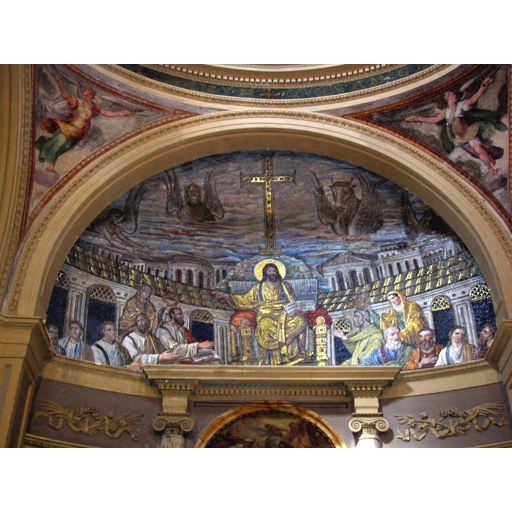
https://en.wikipedia.org/wiki/Santa_Pudenziana
License: unknown
Senator Pudens
Saint- Feast Day
- 19 May
- Gender
- male
- Church
- Catholic
Places
Roles & Family
Biography
Pudens, commonly styled Senator Pudens in later Christian memory, belongs to the first generation of believers associated with the church in Rome. The only document that can reasonably be dated to his own age is a greeting in the Second Epistle to Timothy (4:21), which names Pudens together with Eubulus, Linus, and Claudia among the brethren who send their regards, apparently from the capital of the empire. If that letter reflects conditions in Rome in the later first century, Pudens was already a known member of the Christian community there. No pagan historian, inscription, or administrative record has been securely identified as referring to this man. The senatorial rank is supplied by subsequent ecclesiastical tradition rather than by the New Testament itself, and historians therefore distinguish the biblical name from the fuller portrait drawn in legend.
Roman tradition located his household on the Viminal Hill and identified it with the ancient titulus Pudentis, the titular church that became Santa Pudenziana. That church is among the oldest Christian foundations in Rome; its present fabric and celebrated apse mosaic belong to late antiquity, but the title itself is early. The story that the apostle Peter lodged in the house of Pudens, used it for worship, and baptized members of the family cannot be verified from first-century evidence, yet it shaped the way Romans remembered the site for centuries. The complex of traditions around the titulus made Pudens a type of the aristocratic convert whose property became a house-church and, in time, a public basilica.
The Passio of Saints Pudentiana and Praxedes, a narrative of uncertain date and legendary character, presents Pudens as a senator of a distinguished line, a disciple of the apostles, and the father of two virgin saints, Pudentiana and Praxedes, and in some recensions also of Novatus and Timothy. The Roman Martyrology echoes part of this picture by remembering Pudens as a senator and as the father of the virgin Pudentiana. Those daughters were said to have devoted family wealth to the burial of martyrs and to Christian charity during times of persecution. Because the Passio was composed long after the events it describes and contains conventional hagiographical motifs, the precise family relationships cannot be treated as established historical fact, even though they became standard in Western calendars and in the dedications of Roman churches.
A separate line of interpretation, popular from the early modern period, equated the Pudens and Claudia of the Second Epistle to Timothy with persons mentioned by the poet Martial: a Pudens, sometimes called Aulus Pudens, and a Claudia, in one poem a woman of British origin. Antiquaries in Britain and elsewhere used that equation to claim an apostolic-age link between Rome and Britain, sometimes weaving in the British captive Caratacus. The coincidence of names is real, but Martial’s circle is not independently documented as Christian, and the identification remains a hypothesis rather than a demonstration. The name of Pudens’s wife is therefore not known with certainty from reliable ancient testimony.
No verified year of birth or death survives. If Pudens was a contemporary of the author of Second Timothy, his activity falls in the first century in Rome; later writers who assign him a precise year of death or make him a martyr are not supported by early evidence. Tradition places his burial in the cemetery of Priscilla on the Via Salaria. In the West he is commonly commemorated on 19 May, a date closely tied to the feast of Saint Pudentiana; Eastern calendars that number him among the Seventy Apostles keep other days. He was a layman, not a bishop of Rome or a patriarch, and he founded no religious order. His historical footprint is small; his importance in Christian memory lies in the Roman church’s claim that the faith took root in the house of a named believer of the apostolic age, a claim embodied in the church of Santa Pudenziana and in the cult of his reputed daughters.