Seraphim of Sarov is a saint of the Catholic Church (1754 - 1833). Seraphim of Sarov's feast day is celebrated on 2 January, 19 July.
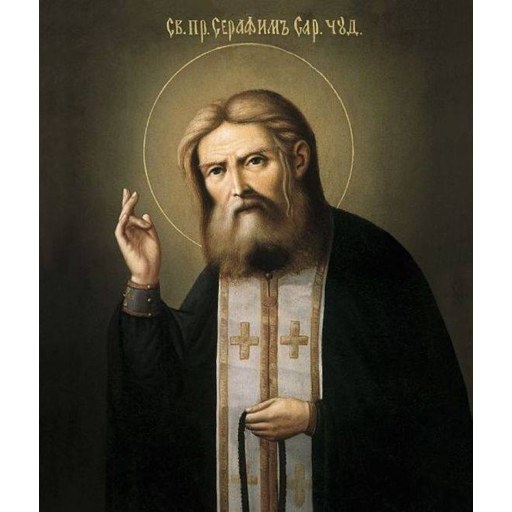
Unknown authorUnknown author
License: CC BY-SA 4.0
Seraphim of Sarov
Saint- Life Span
- 1754 - 1833 (age 79)
- Feast Day
- 2 January, 19 July
- Gender
- male
- Church
- Catholic
Places
Relics & Where to Venerate
Location unknown
The bodily remains of Seraphim of Sarov are a first-class relic. Venerated at Nizhny Novgorod Oblast.
Roles & Family
Canonization
Biography
Seraphim of Sarov, born Prokhor Isidorovich Moshnin in Kursk in the Russian Empire, is among the most widely venerated saints of the Russian Orthodox Church. Traditional hagiography dates his birth to 19 July 1754, though some later reference works give 1759; the year is therefore not beyond dispute, but his origin in a Kursk merchant household is not. His father, Isidor, took part in commercial life and in church building in the city and died while Prokhor was still a child, after which the boy was raised by his mother, Agafia (Agathia). Orthodox accounts of his childhood, written down long afterward, describe a fall from a bell tower from which he was unharmed and a serious illness from which he recovered after a vision of the Mother of God and after being carried to a procession of the Kursk Root Icon of the Theotokos. In his late teens he left home for the Sarov Monastery of the Dormition, a house in the forested country of the Tambov region, and was received there as a novice toward the end of the 1770s.
He was tonsured a monk with the name Seraphim in the mid-1780s and was ordained deacon and, some years later, priest (hieromonk). After serving in the monastery church he withdrew to a hermitage in the surrounding woods, where he lived in great austerity, kept a small garden, and devoted long hours to prayer. Later tradition holds that he spent a thousand days and nights in prayer standing or kneeling upon a rock. In the early nineteenth century he was attacked by robbers who beat him almost to death; the received Life says that he offered no resistance, later asked that his attackers not be punished, and remained bent in posture for the rest of his life because of the injuries. After a further stretch as a recluse inside the monastery precincts he opened his cell to visitors and became known as a starets, a spiritual elder to whom lay people, clergy, and monastics came in large numbers for counsel and blessing.
The teaching associated with him, preserved mainly in nineteenth-century written accounts rather than in texts from his own hand, stresses meekness, continual inner prayer, and what he called the acquisition of the Holy Spirit as the true aim of the Christian life. The best-known record is a conversation reported by the layman Nikolai Motovilov, who described seeing Seraphim transfigured with light during a winter meeting in the forest near Sarov. Popular memory and iconography also attach to him the story of a bear that took food from his hands. He took a close interest in the women’s community at Diveyevo, founded in the eighteenth century by the widow Alexandra (Agafia Semyonovna Melgunova); he gave the sisters a rule of life and is regarded as that monastery’s spiritual father. According to the traditional account he died in January 1833 at Sarov while kneeling in prayer before an icon of the Mother of God.
Veneration of Seraphim spread through the nineteenth century by means of oral reports, printed lives, and pilgrimage. The Russian Orthodox Church glorified him as a saint in 1903 in ceremonies at Sarov attended by Emperor Nicholas II and members of the imperial family; his relics were then exposed for public veneration. After the Bolshevik Revolution the Sarov monastery was closed and the relics were removed and for a time thought lost. They were identified again in 1990–1991 and taken to the Trinity Cathedral of the Seraphim-Diveyevo Monastery, where they remain. He is commemorated on 2 January, the day of his repose in the Julian calendar used by the Russian Church, and on 19 July, the day associated with the uncovering of his relics. His life and sayings occupy a central place in modern Orthodox spirituality, especially in Russia, as a model of eremitic prayer joined to the ministry of an elder.