Seraphim of Vyritsa is a saint of the Catholic Church (1866 - 1949). Seraphim of Vyritsa's feast day is celebrated on 21 March (Julian) / 3 April (Gregorian).
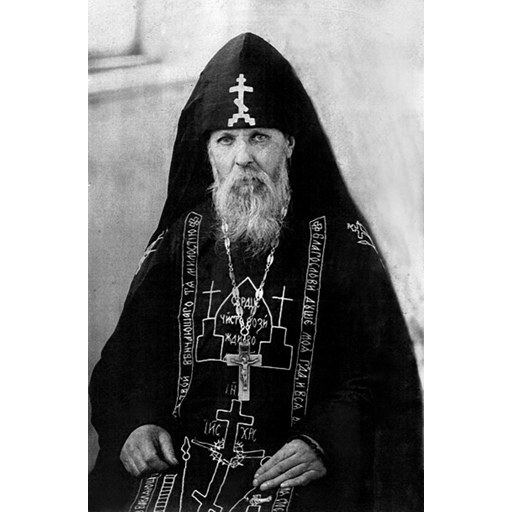
Unknown authorUnknown author
License: Public domain
Seraphim of Vyritsa
Saint- Life Span
- 1866 - 1949 (age 83)
- Feast Day
- 21 March (Julian) / 3 April (Gregorian)
- Gender
- male
- Church
- Catholic
Places
Roles & Family
Religious Information
Canonization
Biography
Seraphim of Vyritsa was born Vasily Nikolayevich Muravyov on 31 March 1866 in the village of Vakhromeyevo, in the Rybinsk district of Yaroslavl Governorate in the Russian Empire. He came from a peasant family; his father was Nikolai Ivanovich Muravyov and his mother Khionia Alimpyevna. After his father’s death, the young Vasily went to Saint Petersburg to earn a living. There he worked in commerce, eventually becoming a successful merchant in the fur trade and a man of considerable means. From childhood he had been devout, and even as a businessman he kept a strict prayer rule, gave generously to the poor and to churches, and hoped one day to become a monk.
He married Olga Ivanovna Netronina, and they had a son named Nikolai. Husband and wife lived in piety and agreed that, once their family duties were fulfilled, they would both enter monastic life. In the aftermath of the 1917 revolutions they carried out that intention. Vasily entered the Alexander Nevsky Lavra in Petrograd in 1920, where he was tonsured a monk with the name Barnabas, ordained priest, and later made archimandrite. He subsequently received the great schema and the name Seraphim, after Saint Seraphim of Sarov. Olga was tonsured a nun and later a schema-nun, taking the name Seraphima. During the 1920s, as the Soviet state closed monasteries and arrested clergy, Seraphim became a widely sought spiritual father in Leningrad.
Serious illness led the church authorities to bless his departure from the city. In 1930 he settled in Vyritsa, south of Leningrad, where he spent the remainder of his life. Despite poor health he received a constant stream of visitors seeking counsel, blessing, and prayer. During the siege of Leningrad and the German occupation of Vyritsa in the Second World War he remained in the town; later accounts describe him praying at length on a stone in imitation of Seraphim of Sarov, asking God to save Russia. He was known among the faithful for gifts of consolation, discernment, and healing.
Seraphim died in Vyritsa on 3 April 1949 and was buried beside the Church of the Kazan Icon of the Mother of God. Popular veneration grew in the following decades. In August 2000 the Jubilee Bishops’ Council of the Russian Orthodox Church, under Patriarch Alexy II, glorified him as a saint for church-wide commemoration. His relics are enshrined in the Kazan church in Vyritsa, which became a place of pilgrimage. The Russian Orthodox Church keeps his feast on 21 March according to the Julian calendar, corresponding to 3 April in the Gregorian calendar.