Serapion the Sindonite is a venerable of the Catholic Church. Serapion the Sindonite's feast day is celebrated on March 21.
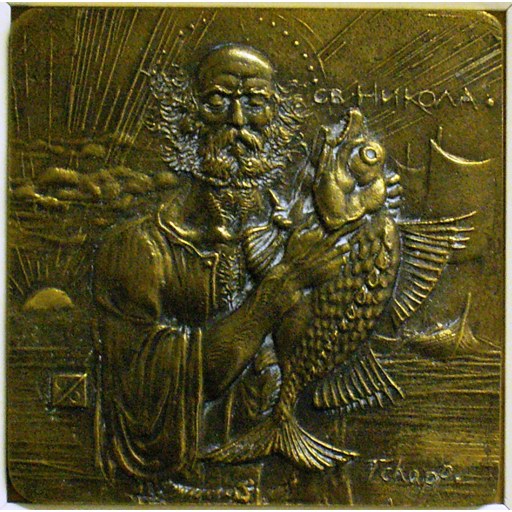
https://en.wikipedia.org/wiki/Icon
License: unknown
Serapion the Sindonite
Venerable- Feast Day
- March 21
- Gender
- male
- Church
- Catholic
Places
Roles & Family
Biography
Serapion the Sindonite, also called Serapion Sindonites, was a Christian monk of Egyptian origin who lived in the fourth century. Nearly everything that can be affirmed of him with historical confidence comes from a single early witness, the Lausiac History of Palladius of Galatia, composed about 419–420. Palladius identifies him as an Egyptian and explains the surname Sindonite by the fact that he wore nothing but a sindon, a linen cloth or simple tunic. He belonged to the world of the Egyptian Desert Fathers, yet unlike the typical cell-dwelling anchorite he refused a fixed dwelling. Palladius portrays him as a practitioner of xeniteia, voluntary exile and homelessness, moving from place to place without property and without provision for the morrow, in a literal reading of the evangelical counsels of poverty.
The same source presents Serapion as a man of unusual missionary zeal who repeatedly sold himself into slavery in order to live among those he hoped to convert. On one occasion he sold himself to a company of actors or theatrical performers for twenty coins and remained in their service until they received baptism; they then freed him, and he gave the money to the poor. In another episode he traveled to Lacedaemon (Sparta) in the Peloponnese and sold himself to a Manichaean husband and wife. For some two years he served them as a household slave. By the example of his life and by instruction he brought them from Manichaeism into the communion of the Church, after which they granted him his liberty. These stories, whatever their exact degree of literal accuracy, reflect a known fourth-century ascetic strategy of self-abasement and of using even degrading social positions as a means of evangelization.
Palladius further relates that Serapion visited Athens, where he encountered pagan philosophers, and that he went to Rome. In the imperial capital he sought an interview with a renowned consecrated virgin who had remained enclosed for twenty-five years and who regarded herself as dead to the world. Serapion challenged this claim. He argued that one who was truly dead to the world would not insist on the honor of enclosure, and that humility rather than spectacular withdrawal was the mark of genuine renunciation. The anecdote functions in the Lausiac History as a warning against spiritual pride among those who practiced extreme forms of the ascetic life. Throughout these narratives Serapion is shown as possessing nothing, storing no food or money, and measuring Christian perfection by interior detachment rather than by the mere external form of monastic enclosure.
Later Orthodox synaxaria and popular lives add wonder-working episodes that do not appear in Palladius, including prayers said to have halted a dangerous rise of the Nile and to have driven locusts from the land, and they state that he died in advanced old age. Such details remain unverified by the earliest witness and should be treated as later hagiographical development. No contemporary document records the year of his birth or death, the town in which he was born, or the place of his burial. He held no episcopal, patriarchal, or papal office. He is honored as a saint in the Eastern Orthodox Church. A number of calendars keep his feast on 21 March; some Slavic traditions also remember him in May.
Serapion the Sindonite should not be confused with Serapion of Thmuis, the fourth-century bishop and theological writer who was a correspondent of Athanasius and a disciple of Anthony the Great, nor with other Egyptian monks of the same name who appear in the Sayings of the Desert Fathers. The Sindonite is specifically the wandering, linen-clad ascetic of Palladius’s narrative. Because the name Serapion was common among Egyptian Christians, later liturgical books sometimes blended commemorations, which helps to explain variation in feast days. The consistent picture left by the earliest source is that of a celibate wandering monk of the Egyptian desert tradition, whose historical footprint is small but vivid, and whose memory was preserved because his poverty and his unconventional methods of converting others impressed the monastic circles of the late fourth and early fifth centuries.