Serena of Rome is a saint of the Catholic Church. Serena of Rome's feast day is celebrated on 16 August.
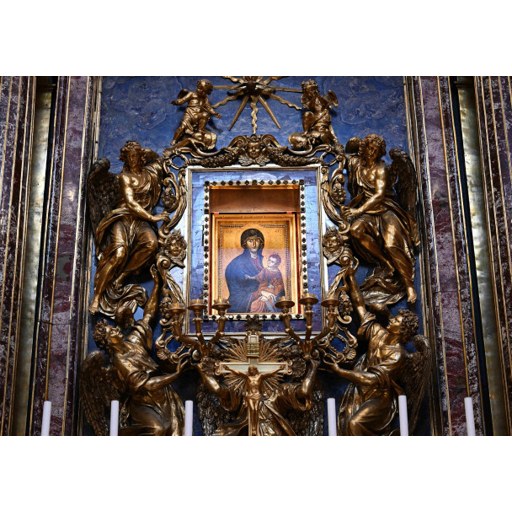
https://legacyicons.com/protectress-of-the-roman-people-icon-from-the-papal-basilica-of-saint-mary-major-rome-t160
License: unknown
Serena of Rome
Saint- Feast Day
- 16 August
- Gender
- female
- Church
- Catholic
Places
Roles & Family
Biography
Saint Serena of Rome is a Christian saint commemorated in the traditional Roman Martyrology on 16 August, where she is listed as having died at Rome and as having formerly been the wife of the Emperor Diocletian. That brief notice is the principal liturgical witness to her cult. No contemporary narrative of her life, passion, or burial survives, and she does not appear in the earliest Roman liturgical documents, such as the mid-fourth-century Depositio martyrum. As a result, almost every biographical particular beyond the martyrology’s short entry remains historically unverifiable.
The identification of Serena as Diocletian’s wife is rejected by modern historians. Fourth-century sources, above all Lactantius, name Diocletian’s spouse as Prisca. Prisca and her daughter Valeria were associated with Christianity; after Diocletian’s abdication they were exiled and were later put to death under Licinius, events usually placed in the 310s. The martyrology’s Serena is therefore generally treated as a hagiographical figure, possibly a later confusion with Prisca, or as the remnant of a local Roman cult that pious tradition attached to the imperial household. Elaborations in later legendaries that present Serena as a convert martyred in the Great Persecution lack corroboration in independent fourth-century evidence and are not accepted as historical.
Nothing reliable is known of her birth, family, or the circumstances of her death. No authentic relics, tomb, or church dedication can be securely tied to her, and she is not associated with a religious order. Patronage traditions, if they ever existed, have not been documented in standard hagiographical reference works. She must also be distinguished from other women named Serena in late antiquity, notably Serena, niece of Theodosius I and wife of the general Stilicho, who was executed at Rome in 408 and was never venerated as a saint.
Serena of Rome therefore belongs to the large class of names preserved in later martyrologies whose cult attests early Christian memory in the city of Rome but whose personal history cannot be reconstructed. The feast on 16 August remains the one firmly attested liturgical fact; birth and death years, marriage, children, and burial place are unknown.