Sergiĭ Mechev is a saint of the Eastern Orthodox Church (1892 - 1942). Sergiĭ Mechev's feast day is celebrated on 6 January.
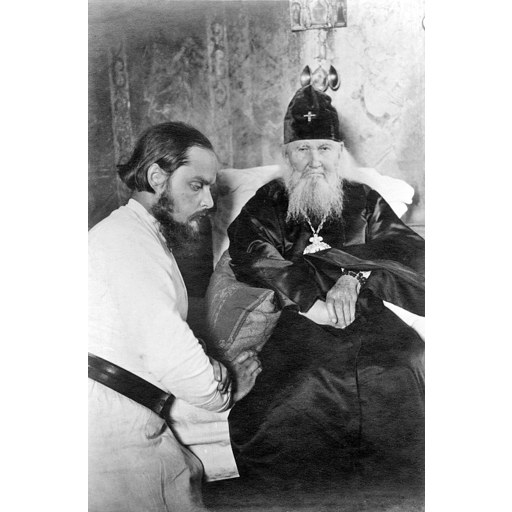
Unknown authorUnknown author
License: Public domain
Sergiĭ Mechev
Saint- Life Span
- 1892 - 1942 (age 50)
- Feast Day
- 6 January
- Gender
- male
- Church
- Eastern Orthodox
Places
Roles & Family
Canonization
Biography
Sergii Alekseevich Mechev was born in 1892 in Moscow, in the family of the Moscow parish priest Aleksei Mechev, later glorified by the Russian Orthodox Church as Righteous Alexis of Moscow. He was raised in the parish of St. Nicholas in Klenniki on Maroseika Street, a community already known in the late imperial period for its intense liturgical life and for the large circle of spiritual children who gathered around his father. After gymnasium he studied at the historical-philological faculty of Moscow University. The collapse of the old order and the Civil War years interrupted ordinary academic and church careers, but he remained attached to the Klenniki parish and to the pastoral tradition formed there.
After the death of Archpriest Aleksei Mechev in 1923, Sergei was ordained to the priesthood and continued his father’s work at the same Moscow church. As a married parish priest (later raised to the rank of protoiereus), he sought to keep alive an inner parish life of frequent confession, careful preaching, and mutual support among the faithful at a time when public church activity was increasingly restricted. The Klenniki community in the 1920s was regarded as one of the more spiritually serious Moscow parishes; Father Sergii’s ministry is described in surviving memoirs as a continuation of his father’s emphasis on the Eucharist and on personal spiritual guidance rather than on political confrontation.
Soviet anti-religious campaigns closed the church and repeatedly brought him under arrest. He spent long periods in prisons and labor camps in the late 1920s and 1930s. Arrested again toward the end of that decade, he was held in Yaroslavl during the early years of the Second World War. A tribunal there condemned him to death, and he was shot on 6 January 1942. The place of burial is not known; like many executed in that period, he was almost certainly interred in an unmarked mass grave.
The Jubilee Bishops’ Council of the Russian Orthodox Church in 2000 glorified him as a hieromartyr among the New Martyrs and Confessors of Russia. He is commemorated on the day of his death (6 January in the civil calendar, corresponding to 24 December on the Julian liturgical calendar) and in the general synaxis of the New Martyrs. His memory is bound up with that of his father and with the Klenniki parish tradition: a married city priest who tried to preserve ordinary sacramental and pastoral life under persecution and who died for that fidelity.