Sergius and Bacchus is a saint of the Catholic Church (d. 303). Sergius and Bacchus's feast day is celebrated on 7 October. Sergius and Bacchus is the patron saint of Syria;soldiers;Arab Christians;Resafa.
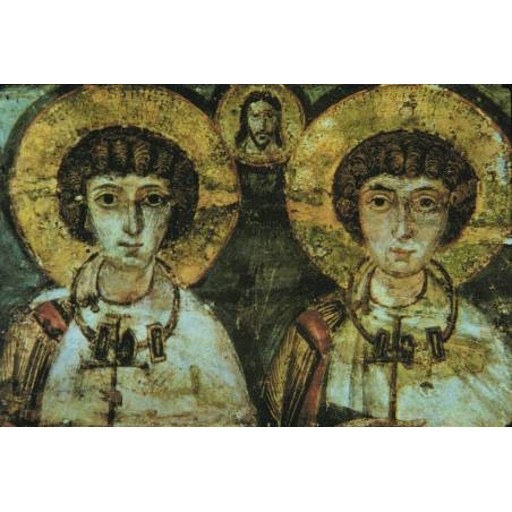
License: Public domain
Sergius and Bacchus
Saint- Life Span
- d. 303
- Feast Day
- 7 October
- Gender
- male
- Church
- Catholic
Places
Sacred Place

Roles & Family
Patronage
Syria;soldiers;Arab Christians;Resafa
Biography
Saints Sergius and Bacchus are early Christian martyrs commemorated jointly in the Catholic, Eastern Orthodox, and Oriental Orthodox churches. Almost nothing about their lives can be established from contemporary documentary sources. The principal narrative is a Greek Passion (Passio), generally thought to have been composed in the fifth century, long after the events it describes. That text presents them as high-ranking officers in an elite palatine unit, the schola gentilium, attached to the imperial court in the Roman East. The emperor named in the Passion is Maximianus, a figure later readers have identified with Maximian, Galerius, or another tetrarch of the late third and early fourth centuries. The martyrs are said to have been secret Christians of distinguished standing who refused, when ordered, to enter a temple of Jupiter and take part in sacrifice. Places and dates of birth are unknown; later claims of noble Roman origin are conventional hagiographic coloring rather than verified biography.
According to the Passion, once their Christianity was exposed they were stripped of belts, torques, and other military insignia, dressed in women’s clothing as a public humiliation, and paraded before the army and the court. Bacchus was then taken to Barbalissos (Barbalissus) on the Euphrates and scourged so severely that he died under the lash. Sergius was forced to march in footwear fitted with nails or spikes across the Syrian desert to the fortress of Resafa (also spelled Rasafa or Rusafa). There, after further torment, he was beheaded. Tradition assigns these deaths to 7 October 303, in the setting of the Diocletianic persecution. The Passion itself does not independently fix a calendar year, and modern historians treat 303 as a conventional date rather than a fact confirmed by a contemporary chronicle. Eusebius and other fourth-century historians do not mention the pair.
The cult that grew around them, and especially around Sergius, became one of the most important in the Christian East. A shrine developed over Sergius’s tomb at Resafa, which in the fifth and sixth centuries expanded into a major walled pilgrimage city known as Sergiopolis. The Christian Arab Ghassanid phylarchs were particularly devoted to Saint Sergius; churches, monasteries, and desert shrines dedicated to him spread along the Syrian and Arabian frontier. Emperor Justinian I and Empress Theodora endowed the sanctuary at Resafa, and Justinian also built the Church of Saints Sergius and Bacchus in Constantinople (later called Little Hagia Sophia). Relics and dedications carried the cult into Asia Minor, Mesopotamia, Rome, and Gaul. In Byzantine military piety Sergius and Bacchus ranked among the great warrior saints, often shown in art as two young officers in court or military dress, holding crosses or martyr’s palms.
They are commemorated on 7 October in the Roman Martyrology and in the calendars of the Eastern Orthodox Church and several Oriental Orthodox churches. Like other pre-Constantinian martyrs they were not the object of a later papal process of canonization; their status rests on early popular veneration and on episcopal recognition of the cult. Scholarly opinion on historicity remains divided. Some historians allow a kernel of fact—two soldiers executed in Roman Syria whose tombs attracted devotion—while others regard the Passion as largely legendary and possibly indebted to earlier military-martyr narratives. No reliable evidence records a spouse or children. What is secure is that by the fifth century their names were already established in the Syrian sanctoral, and that the shrine at Resafa shaped the religious and political landscape of the eastern desert frontier for centuries.