Sergius of Cappadocia is a saint of the Catholic Church (d. 304). Sergius of Cappadocia's feast day is celebrated on 24 February.
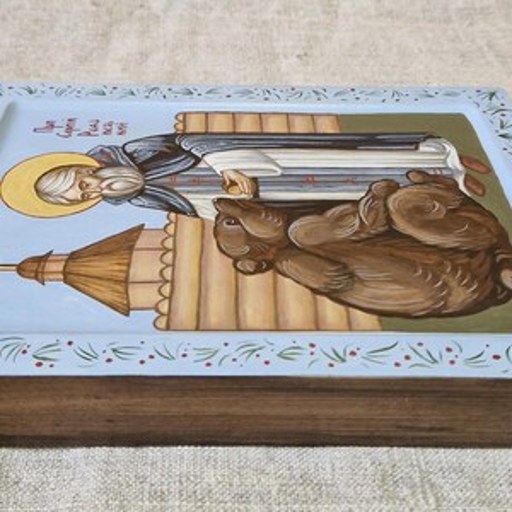
https://www.etsy.com/listing/1825252485/hand-painted-icon-of-saint-sergius-of
License: unknown
Sergius of Cappadocia
Saint- Life Span
- d. 304
- Feast Day
- 24 February
- Gender
- male
- Church
- Catholic
Places
Roles & Family
Canonization
Biography
Sergius of Cappadocia is an early Christian saint whose memory is preserved almost exclusively in brief martyrological notices rather than in any full contemporary biography. He is described as a native of Cappadocia, the highland region of central Anatolia that formed a Roman province and that, by the late third and early fourth centuries, already possessed a well-established Christian community. The date of his birth is unknown. The only chronological anchor supplied by tradition is his death in 304, during the Great Persecution that began under the emperor Diocletian in 303 and continued, with varying intensity, into the following years. Because so little can be verified from independent historical sources, any account of his life must remain cautious and must distinguish the thin core of the tradition from later legendary elaboration.
The surviving notices identify Sergius as a monk. In the Cappadocia of his time, monasticism was still a relatively new form of Christian life, taking shape under the influence of Egyptian models and of local ascetics. Organized Cappadocian monasticism would later be associated with Basil of Caesarea, who belonged to a subsequent generation; already around the year 300, however, men and women were withdrawing from ordinary civic and family obligations to pursue prayer and ascetic discipline. As a monk, Sergius would have been expected to remain unmarried and without children, and no source attributes a spouse or offspring to him. That religious commitment placed him in direct conflict with imperial policy that, from 303 onward, required Christians to sacrifice to the gods of Rome and to surrender sacred books.
Tradition holds that Sergius was arrested in the course of this persecution and brought before the authorities at Caesarea, the capital of the province of Cappadocia (the city later known as Caesarea Mazaca and today as Kayseri in Turkey). There he refused to apostatize. The notices state that he was subjected to torture and that he died as a result of the sufferings inflicted upon him, or that he was executed. No extended passio describing the interrogations, the names of the judges, or the precise manner of death has come down from antiquity, and he is not individually named in the surviving books of Eusebius of Caesarea in a way that would allow a fully historical identification independent of later calendars. The year 304 is the date conventionally assigned to his martyrdom.
Veneration of Sergius as a martyr is attested by his inclusion in medieval Western martyrologies. In the Roman Catholic tradition his feast has been kept on 24 February. He belongs to the large company of saints whose cult arose by popular and liturgical custom before the Holy See developed a centralized process of canonization, and he is therefore classified as a pre-congregation saint. No reliable information survives concerning the place of his burial, and no well-documented patronages of places, professions, illnesses, or groups are attached to his name in the sources. The historical record yields only a sparse outline: a Cappadocian monk who died for the Christian faith at Caesarea during the Diocletianic persecution and who was thereafter commemorated as a martyr.