Seven Holy Founders of the Servite Order is a saint of the Catholic Church. Seven Holy Founders of the Servite Order's feast day is celebrated on 17 February.
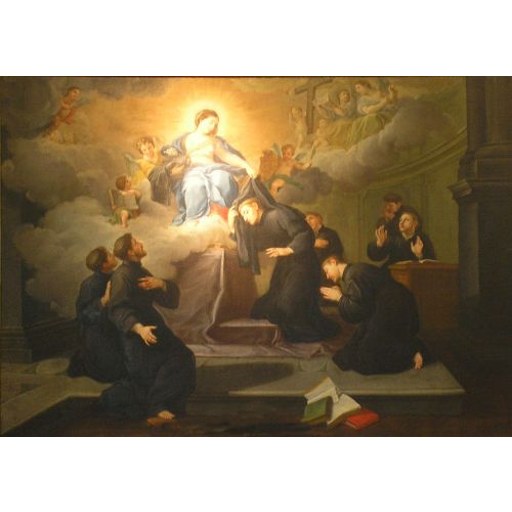
Unknown, Italian
License: Public domain
Seven Holy Founders of the Servite Order
Saint- Feast Day
- 17 February
- Gender
- male
- Church
- Catholic
Places
Roles & Family
Religious Information
Canonization
Biography
The Seven Holy Founders of the Servite Order were, according to the tradition of the Order of Friar Servants of Mary, seven men of Florence who in the thirteenth century left secular life to form a religious community dedicated to the Blessed Virgin Mary. Later Servite sources name them as Bonfilius Monaldi, Alexis Falconieri, John Bonagiunta, Benedict dell'Antella (also called Manettus), Bartholomew Amidei (also called Amadeus), Gerard Sostegni (also called Sostene), and Ricoverus Uguccione (also called Hugh). They are described as members of leading Florentine merchant families and as belonging to a Marian lay confraternity in the city. The traditional date associated with their common vocation is 1233, often connected with the Feast of the Assumption, 15 August. Contemporary thirteenth-century records of the early Servites are sparse, and much of the detailed story of a simultaneous vision granted to a tightly knit band of seven founders was written down in later medieval and early modern Servite historiography. Historians therefore treat some of the more picturesque narrative particulars as pious tradition rather than as fully documented chronicle, while still accepting that a Florentine Marian community of this kind took shape in the second quarter of the thirteenth century and became the Servite Order.
Tradition holds that the Virgin Mary appeared to them, sometimes described as clothed in mourning, and called them to withdraw from the world, to serve her, and to contemplate her sorrows at the foot of the Cross. They first retired to a house outside the walls of Florence and then, seeking greater solitude, settled on Monte Senario, a mountain north of the city. There they adopted an austere common life of prayer, fasting, and manual work, and they wore a black habit in memory of Mary's sorrows. From this eremitical beginning the community developed into the Order of Friar Servants of Saint Mary, commonly called the Servites, which combined contemplative devotion to Our Lady of Sorrows with preaching and other apostolic work in the towns of Italy and, in time, beyond. The early community received the support of the bishops of Florence. Papal recognitions followed in the thirteenth and early fourteenth centuries; a bull of Pope Alexander IV in 1256 is among the documents cited for the order's early standing, and later confirmation associated with Pope Benedict XI in 1304 helped secure the Servites' place among the mendicant orders of the Western Church. As the congregation grew, several of the founders were sent to establish or govern houses away from Monte Senario.
The seven did not die together. Most are said to have died in the later thirteenth century at various Servite houses; Alexis Falconieri, commonly regarded as the last survivor of the group, is traditionally reported to have died in 1310, at a very advanced age, at Monte Senario. Individual biographies of the seven remain thin: later legend assigned some of them prior marriages or widowhood and attributed to others a lifelong celibacy, but such details are not established by contemporary evidence. Their memory was cultivated especially at Monte Senario and at the Servite basilica of the Santissima Annunziata in Florence, the city's principal Servite church, where relics associated with the founders were enshrined and where a strong popular cult developed.
Liturgical veneration of the founders as a single group rather than as seven independently celebrated saints grew within the order in the early modern period. Pope Clement XI beatified them in 1717. Pope Leo XIII canonized them jointly on 15 January 1888. Their feast was inserted into the General Roman Calendar; after adjustments of date in the twentieth century, the memorial is kept on 17 February. They are honored as models of conversion from prosperous civic and commercial life to religious poverty, of brotherhood in a common vocation, and of corporate devotion to the Mother of God in medieval Italy. The Servite Order they began continues as a mendicant religious family in the Catholic Church, with the black habit and the devotion to Our Lady of Sorrows as enduring marks of their foundation.