Severian is a saint of the Catholic Church.
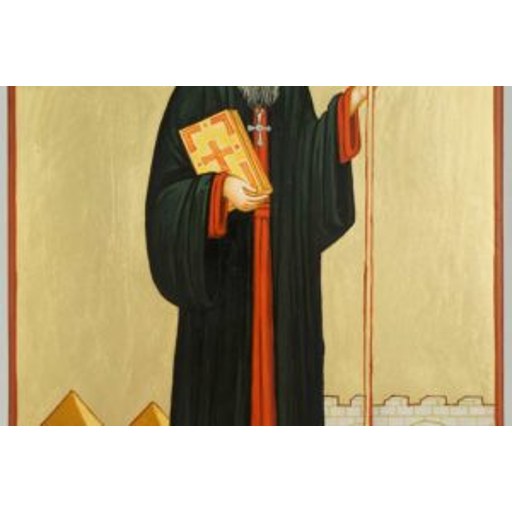
https://blessedmart.com/shop/hand-painted-icons/male-saints-icons/saint-severus-of-antioch
License: unknown
Severian
Saint- Gender
- male
- Church
- Catholic
Roles & Family
Biography
The name Severian, rendered in Latin as Severianus and in Greek as Severianos, is borne by several distinct persons in late antique Christianity. They are not one man, and the surviving evidence for each is of a different kind: brief notices in martyrologies and synaxaria, a body of Greek homilies, conciliar and ecclesiastical narrative, and Roman legendary cycles. Because the present subject is identified only as Severian, without a see, a feast, or a catalogue number, a single verified birth year, death year, city of birth, or place of burial cannot be assigned. What follows therefore distinguishes the principal figures rather than conflating them.
The martyr commemorated as Severian of Sebaste is linked in both Eastern and Western tradition to the Forty Martyrs of Sebaste, soldiers said to have been exposed on ice under the emperor Licinius in the early fourth century in Armenia Minor. Later hagiography presents Severian as a soldier, or in some tellings a senator of the city, who visited the Forty in prison, strengthened them, and was then himself arrested. The Roman Martyrology, on 9 September, calls him a soldier of Licinius who was suspended with a stone tied to his feet, beaten, and torn with iron claws. Byzantine liturgical books more often remember him on 9 February and likewise connect him with the Forty. These entries attest a cult; they do not constitute independent fourth-century documentation of his birth, family, or the exact year of death. Sebaste is the city later called Sivas. No ancient source that can be checked records a wife, children, or membership in a religious order for this martyr, and he was neither bishop of Rome nor a patriarch.
A different and better-documented Severian was bishop of Gabala, a coastal city of Syria Prima, at the end of the fourth century and the beginning of the fifth. He came to Constantinople as an already consecrated bishop and gained a reputation as a preacher at court. At first received by John Chrysostom, he became Chrysostom’s adversary, aligned himself with the empress Eudoxia, and sat in the Synod of the Oak in 403, which deposed the archbishop. A substantial set of homilies and exegetical discourses survives under his name, including treatments of the creation narrative and of Genesis; some of these texts circulated for centuries among the works of Chrysostom and have had to be reassigned by modern editors. His theology and method belong to the Antiochene tradition of literal and historical reading of Scripture. His year of birth is unknown. He outlived Chrysostom’s exile of 404; estimates that place his death in the earlier fifth century, sometimes near the middle of the 420s, are not anchored by a contemporary obituary. He held an ordinary episcopal see, not the patriarchate of Antioch and not the see of Rome. Nothing reliable is known of marriage or offspring.
Yet another Severian was bishop of Scythopolis, the city of Beth-Shean in Palestine. After the Council of Chalcedon in 451 he stood with the Chalcedonian party. In the violence that followed, often placed in 452, he was killed by opponents of the council and was thereafter counted a martyr for the Chalcedonian settlement. Some calendars keep his memory on 21 February. A further Severianus is named among the Four Crowned Martyrs, whose Roman cult is attached to the church of Santi Quattro Coronati and to the feast of 8 November. Late legends describe them either as Pannonian stonemasons who refused to carve a pagan statue or as Roman soldiers executed under Diocletian; the names Severus, Severianus, Carpophorus, and Victorinus belong to this cycle, but the historical individuals behind the names cannot be recovered with confidence.
None of these men is known to have been pope or catholicos-patriarch. Patronages specifically and consistently attached to a single Saint Severian—beyond the local memories of Sebaste, Scythopolis, and the Roman Quattro Coronati—are not securely listed in the standard martyrologies. Canonization in the modern papal sense does not apply to these late antique cults, which arose by popular and liturgical reception long before the later medieval and Tridentine processes. In the absence of a disambiguating identifier, fields that demand one verified life remain empty rather than filled by conjecture.