Shushanik is a saint of the Catholic Church (d. 475). Shushanik's feast day is celebrated on 17 October.
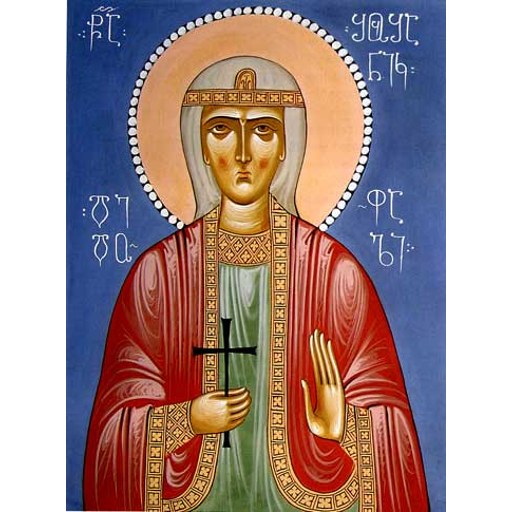
Unknown authorUnknown author
License: Public domain
Shushanik
Saint- Life Span
- d. 475
- Feast Day
- 17 October
- Gender
- female
- Church
- Catholic
Places
Roles & Family
Religious Information
Biography
Saint Shushanik was a fifth-century Armenian Christian noblewoman, the daughter of Vardan Mamikonian, hereditary sparapet of Armenia and leader of the Armenian forces at the Battle of Avarayr in 451. Raised in a family that had long identified with the Christian faith established in Armenia in the early fourth century, she was married to Varsken, a Mihranid pitiakhsh who governed the frontier district of Gugark under Sassanid Persian overlordship. The marriage joined two of the principal aristocratic houses of the Christian Caucasus at a time when the Sassanid state was pressing its Caucasian vassals toward Zoroastrianism.
In the 460s Varsken traveled to the Persian court, where he converted to Zoroastrianism in order to secure royal favor, probably under King Peroz I. On his return he demanded that Shushanik abandon Christianity. She refused. According to the contemporary Passion written by her confessor, the priest Jacob of Tsurtav, she withdrew from conjugal life, laid aside her ornaments, and adopted an ascetic regimen of prayer and fasting while remaining at the fortress of Tsurtavi. Varsken then subjected her to years of beatings, chaining, and imprisonment. Jacob continued to minister to her in secret, bringing the Eucharist and later composing the account of her sufferings. The Passion indicates that she and Varsken had children, whom he used as a means of coercion; she would not recant.
After approximately six years of maltreatment Shushanik died at Tsurtavi in 475. Local clergy buried her there. Varsken persisted in a pro-Persian policy until he was killed about 482 by Vakhtang I Gorgasali, king of Iberia, who was then asserting greater independence from Ctesiphon. The Passion of Saint Shushanik, written shortly after her death, is regarded as the earliest surviving original work of Georgian literature and a principal source for the social and religious history of fifth-century Caucasia. There has been scholarly discussion of a possible Armenian original, but the received text is Georgian.
Shushanik was venerated as a martyr from an early date in both Georgia and Armenia. The Georgian Orthodox Church commemorates her on 17 October; she is also honored in the Armenian Apostolic Church and in Eastern Orthodox calendars. Her cult presented aristocratic fidelity to Christianity as a form of resistance to imperial religious policy, a theme that resonated throughout medieval Caucasian hagiography. Relatively little is known of her life beyond the Passion and the political context of Vardan Mamikonian, Varsken, and Vakhtang; later medieval elaborations should be treated with caution.