Sigismund is a saint of the Catholic Church (d. 524). Sigismund's feast day is celebrated on 1 May. Sigismund is the patron saint of Bohemia;Czech Republic.
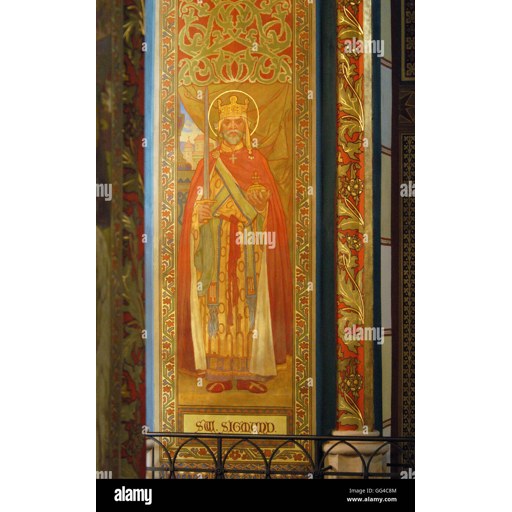
https://alamy.com/stock-photo/saint-sigismund.html
License: unknown
Sigismund
Saint- Life Span
- d. 524
- Feast Day
- 1 May
- Gender
- male
- Church
- Catholic
Places
Roles & Family
Religious Information
Patronage
Bohemia;Czech Republic
Biography
Sigismund was king of the Burgundians in the early sixth century and is venerated as a saint in the Catholic Church. He was the son of Gundobad, who ruled the Burgundian kingdom centered on Lyon and Geneva, a realm established by the Burgundians in former Roman provinces of eastern Gaul. No contemporary source records the year or place of his birth. Like other members of the Burgundian royal house he was initially an Arian Christian. Under the influence of Avitus of Vienne, one of the leading Catholic bishops of Gaul, Sigismund converted to Nicene Christianity while his father still reigned. The conversion marked an important shift in Burgundian royal policy toward the Catholic Gallo-Roman majority and toward neighboring Catholic and recently converted courts.
Sigismund succeeded Gundobad as king around 516. He married Ostrogotho, a daughter of Theodoric the Great, thereby creating a dynastic alliance with the Ostrogothic kingdom of Italy. They had a son, Sigeric. After Ostrogotho's death Sigismund took a second wife. According to the narrative preserved by Gregory of Tours, this second wife accused Sigeric of plotting against his father. In 522 Sigismund ordered his own son strangled. Seized with remorse, he undertook public penance and became the principal founder and patron of the monastery of Saint-Maurice at Agaunum in the Valais, where he instituted a liturgy of perpetual psalmody.
Frankish intervention ended his reign. In 523 the sons of Clovis I invaded Burgundy. Sigismund was defeated and fled to the monastery at Agaunum seeking sanctuary, but was seized together with his remaining family and taken captive to Orléans by Chlodomer. In 524, before a further campaign against Sigismund's brother Godomar, Chlodomer had Sigismund, his wife, and his surviving sons put to death. Tradition holds that they were thrown into a well in the Orléans region. Godomar later defeated and killed Chlodomer at Vézeronce, but Burgundian independence did not long survive.
Despite the filicide that stained his reputation, Sigismund was soon honored as a martyr. His violent death, Catholic conversion, and monastic foundations provided the basis for a cult. His remains were recovered and translated to the Abbey of Saint-Maurice. In the fourteenth century the Holy Roman Emperor Charles IV, who regarded Sigismund as a personal patron, obtained relics and established his cult in Bohemia, placing them in Prague. Sigismund thus became one of the patron saints of Bohemia and is still counted among the patrons of the Czech lands. His feast is kept on 1 May. He was never the subject of a formal papal canonization of the later medieval type; his cult grew from early medieval veneration.